
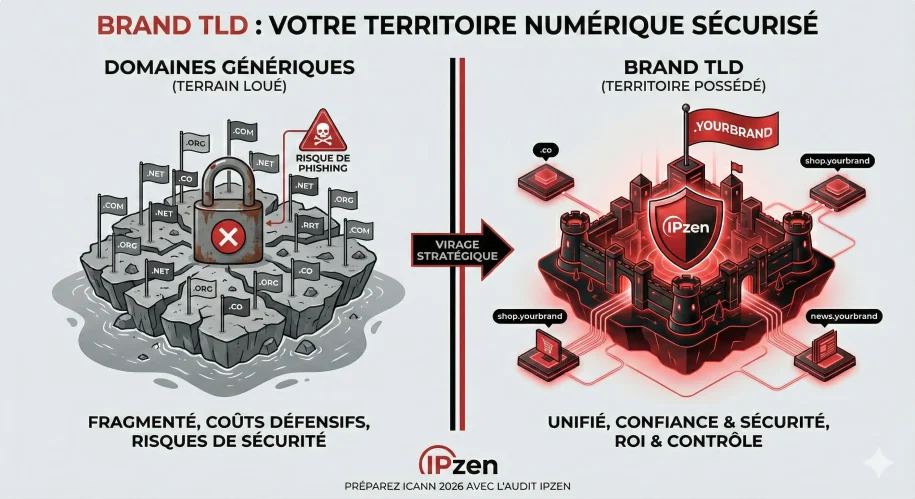
In today’s digital economy, most companies manage their domain names defensively: purchasing hundreds of variants in .com, .net, or country codes (like .fr or .uk) to prevent third parties from using them. This is a cost-based strategy, often perceived as an unavoidable “tax.”
However, a silent revolution is underway among Retail, Technology, and Finance giants. Instead of renting land on someone else’s property (generic extensions), they are building their own digital territory: the Brand TLD (Top-Level Domain).
Major players like .kpmg, .hsbc, or .sncf have transformed what was once a mere technical address into a powerful lever for trust and security.
Why should you reconsider your naming strategy now, as the new ICANN 2026 application window approaches? Here is an analysis of a strategic asset that is still vastly underestimated.
- Security by design: The end of phishing?
This is the number one argument for sensitive sectors like Banking and Finance. On a standard domain (yourbank.com), you share the extension with millions of other owners, including potentially malicious actors practicing typosquatting.
With a Brand TLD (e.g., .yourbrand), you are the Registry. You own the entire extension.
- Total lockdown: No one but you can create a domain ending in .yourbrand.
- Forced authentication: Brand TLDs allow you to enforce strict security protocols (like preloaded HSTS) across the entire extension.
- The result: A user seeing a URL like login.yourbrand or secure.amazon has an absolute technical guarantee that they are on your legitimate site. The risk of phishing via homoglyphs collapses.
Key Figure: According to industry studies, over 80% of internet users report feeling more confident when navigating a website that uses an official brand extension.
- Retail & CX: The era of “digitals”
In Retail, the fragmentation of customer journeys is a plague. Between e-commerce sites, corporate sites, and local store pages, the customer gets lost.
The Brand TLD allows you to restructure this ecosystem with disarming clarity. Take the example of major retailers who have migrated from a multitude of disparate domains to a unified architecture around their .brand:
- travel.brand
- auto.brand
- shop.brand
This strategy not only improves SEO by concentrating domain authority, but it primarily simplifies the consumer’s life. The extension becomes a seal of quality and belonging.
- The ROI of a brand TLD: Beyond cost, value
This is often the main hurdle: “Having your own extension is expensive.” Admittedly, the entry ticket with ICANN and technical maintenance fees are significant. But as highlighted by recent studies on the ROI of Brand TLDs, you have to look at the global balance.
A Brand TLD allows for substantial savings elsewhere:
- Reduction of defensive buys: No need to buy https://www.google.com/search?q=brand-promo.com, brand-blackfriday.net, etc. You create promo.brand for free and instantly.
- SSL certificates & security: Centralized management reduces the administrative costs of securing thousands of subdomains.
- Marketing efficiency: Short, memorable URLs (careers.kpmg instead of kpmg.com/us/careers) increase conversion rates and campaign efficiency (especially on mobile and QR codes).
Depending on the model, the break-even point of a Brand TLD project can be reached by year 3 or 4 thanks to these economies of scale.
- Preparing for 2026: The importance of a preliminary audit with IPzen
Launching your own extension cannot be improvised. The next ICANN (Internet Corporation for Assigned Names and Numbers) application window is expected in 2026, but the application file must be built today.
The first step is a financial and strategic audit. This is where a portfolio management software like IPzen becomes your best ally to build your Business Case:
- Analyze your current costs: How much do you really spend on defensive purchases, recovering squatted domains, and useless renewals? IPzen centralizes these costs to help you calculate your future break-even point.
- Map your Aassets: Identify geographical areas where you are vulnerable and those where a Brand TLD would simplify your architecture.
- Justify the investment: Without a clear, quantified view of your current portfolio (provided by IPzen reports), it is impossible to justify the investment of a Brand TLD to your Executive Board.
Conclusion: From stock management to flow management
Owning a Brand TLD means moving from the status of a “tenant” on the internet to that of a “landowner.” It offers unmatched security and visibility, but it requires maturity in IP asset management.
Do not let the complexity of the audit deprive you of this strategic opportunity.
Prepare your transition to a Brand TLD with IPzen. Portfolio audit, cost analysis, data centralization: our tools are designed to structure your approach and secure your application for ICANN 2026.