

Intangible assets now represent 90% of the market capitalization of the S&P 500 – compared to just 17% in 1975 (source: Ocean Tomo). Yet a study of 1,200 senior managers reveals that 57% report lost time due to inaccurate spreadsheets, and 17% of large enterprises have suffered direct financial losses linked to spreadsheet errors (source: Ventana Research, The Risk of Spreadsheet Errors).
In other words: intellectual property has never been more valuable, and it has never been more poorly managed in most organizations.
This guide is for chief legal officers, IP managers and decision-makers who want to structure, professionalize and optimize their intellectual property portfolio management. You’ll find concrete methodology, actionable checklists and objective criteria for selecting the right tools.
Quick summary: This article covers the 5 components of an IP portfolio (trademarks, patents, designs, domain names, trade secrets), the 5 most common mistakes illustrated with real case studies, a 10-step audit methodology with downloadable checklist, a detailed Excel vs. software comparison, objective criteria for choosing an IPMS, and an honest breakdown of 2026 trends (AI, cloud, automation). Reading time: approximately 15 minutes.
Sommaire
- 1 What is an intellectual property portfolio?
- 2 Why IP portfolio management is a strategic priority
- 3 The 5 most common IP portfolio management mistakes
- 4 Criteria for choosing an IP management solution
- 5 Implementation: from spreadsheet to cloud platform
- 6 2026 trends: what’s really changing (beyond the marketing)
- 7 Conclusion: IP management as investment, not expense
- 8 FAQ
What is an intellectual property portfolio?
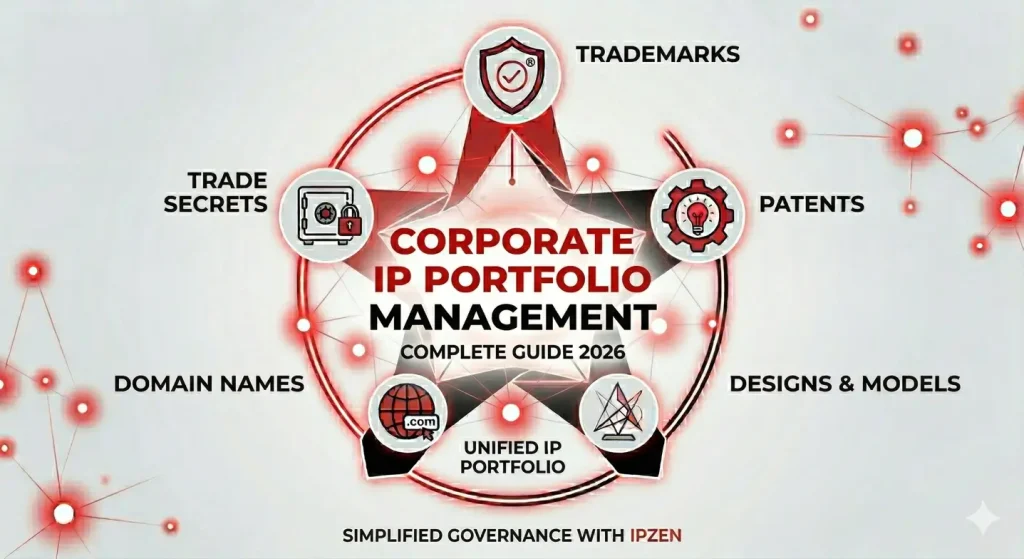
An intellectual property portfolio brings together all intangible assets protected by exclusive rights. For a mid-sized company or large group, this portfolio typically consists of five major categories of assets.
Trademarks
Trademarks are often the largest intellectual property asset by volume. They cover distinctive signs (including names, logos, and slogans, as well as, in some cases, sounds, shapes, or colors) registered with national offices (USPTO in the United States), regional offices (EUIPO for the European Union) or internationally (Madrid system via WIPO). In 2024, trademark filing applications worldwide reached 11.5 million according to WIPO, demonstrating the growing importance of trademark protection.
Each trademark must be monitored, renewed (typically every 10 years) and defended against potential infringement: counterfeiting, cybersquatting, unauthorized use on marketplaces. For a deeper dive into this topic, see our guide on trademark portfolio management.
An often-overlooked point: the choice of Nice classes at filing is crucial. Poor classification can leave gaps in your protection or generate unnecessary costs by covering non-relevant classes. This is why an intellectual property management tool that integrates Nice nomenclature and an analysis of the categories used by your competitors is a significant advantage.
Study: According to EUIPO/EPO research, SMEs that own IP rights generate more revenue per employee, pay higher salaries and are 10 times more likely to attract investors than those that don’t (EUIPO – EPO SME Scoreboard 2024).
Patents
Patents protect technical inventions and grant a 20-year exclusive exploitation monopoly. Their management is more complex than trademarks because each patent generates annual fees in every country where it’s validated. For a European patent validated in 20 countries, annual maintenance costs can range from hundreds to thousands of euros per jurisdiction.
Global patent filing activity increased by 4.9% in 2024, reaching 3.7 million applications. China leads with 1.8 million filings, followed by the United States and Japan.
Designs and models
Designs protect the appearance of a product: its shape, lines, colors and texture. They are particularly important in luxury, fashion, industrial design and tech (interface design) sectors.
Domain names
Domain names are an often-underestimated IP asset. A domain portfolio protects a company’s online presence and prevents cybersquatting. Management involves tracking renewals, monitoring similar registrations and implementing UDRP procedures if infringement occurs. Discover our features dedicated to domain name management.
Trade secrets
Since the EU Trade Secrets Directive 2016/943, trade secrets benefit from a strengthened legal framework. Their management relies on documented confidentiality measures: non-disclosure agreements, access controls and consultation traceability.
Why IP portfolio management is a strategic priority
Intellectual property is no longer just a legal matter. It has become a strategic lever for value creation, financing and competitiveness.
Protecting company value
A forgotten patent that falls into the public domain or an unrenewed trademark is a strategic asset permanently lost. The financial consequences can be significant: loss of exclusive exploitation, market opening to competitors, inability to license or sell the right in question.
IP assets can serve as collateral for financing and are valued during fundraising, M&A transactions and due diligence audits. Deficient management can directly affect the company’s financing capacity.
Regulatory compliance
The entry into force of the Unified Patent Court (UPC) in 2023 added complexity for European patent holders. Companies must now manage opt-out decisions, follow UPC procedures and adapt their filing strategy.
Similarly, the European Digital Services Act (DSA) strengthens company obligations regarding counterfeit detection and reporting on online platforms.
Competitive advantage
Companies that actively manage their IP portfolio can identify monetization opportunities (licenses, assignments), detect infringements quickly and make informed decisions about IP budget allocation. Conversely, passive management exposes companies to costly risks.
Study: According to EUIPO 2024 data, counterfeiting costs major industries 6.8 billion euros annually – representing 5.8% of direct sales – and 35,124 jobs across key economic sectors. At European scale, this figure reaches 60 billion euros. Early infringement detection through automated monitoring significantly reduces these losses.
The 5 most common IP portfolio management mistakes
After years of helping companies structure their IP management, here are the five mistakes that recur most frequently.
Mistake #1: managing your portfolio on Excel
The spreadsheet remains the most widespread IP management tool in SMEs and mid-market companies. The problem: Unless specifically configured, there are no reliable automatic alerts for due dates, risk of data entry errors, no access control, inability to track modification history and difficulty producing reliable reports.
Case study: A mid-market cosmetics company managed 120 trademarks on a shared Excel file between three people. In 2024, a date error led to the non-renewal of a flagship trademark in 3 Middle Eastern countries. Estimated cost: 18 months for re-filing procedures, 45,000+ euros in legal fees, plus a 6-month window during which a local distributor registered a nearly identical name. A simple automatic alert would have prevented all this.
Mistake #2: working in departmental silos
In many organizations, IP management is scattered across legal (trademarks, contracts), R&D (patents, inventions), marketing (domain names, trademark) and IT (software, licenses). Without consolidated visibility, inconsistencies emerge: trademarks registered in inappropriate classes or with inappropriate class descriptions , patents maintained on abandoned technologies, duplicate domain names.
Case study: An industrial group discovered during an audit that it was paying maintenance fees for 35 patents related to a product line discontinued 3 years earlier. R&D had informed senior management, but the information never reached the legal department managing renewals. Unnecessary cost: over 80,000 euros over 3 years.
Mistake #3: neglecting monitoring
Filing a trademark or patent is not enough. Without active monitoring, companies don’t detect infringements: similar trademark filings by third parties, counterfeits on marketplaces, cybersquatting on similar domain names. Time works against the rights holder: the later an infringement is detected, the harder and more costly it is to fight.
Case study: A French apparel trademark discovered by chance – through a customer – that a third-party seller had been using its trademark on Amazon for 8 months. The detection delay made the removal procedure more complex and required specialized legal intervention. With automated domain name and marketplace monitoring, the infringement would have been detected within 48 hours.
Mistake #4: underestimating IP budget
Many companies view IP as a cost center rather than an investment. Result: insufficient budgets to renew the entire portfolio, poorly informed decisions about which rights to maintain or abandon, and litigation or opposition procedures delayed due to lack of funds.
The reality is that every euro invested in IP protection generates far better returns by avoiding costly litigation, protecting licensing revenue and strengthening company valuation during fundraising or M&A operations.
Mistake #5: failing to engage leadership
When IP remains confined to the legal department without reporting to senior management, strategic decisions (geographic expansion, monetization, assignment) aren’t made at the right time. IP must be integrated into company governance with clear performance indicators and regular executive reporting.
Our recommendation: present a quarterly IP dashboard to the C-suite with 4 key metrics – number of assets by category, critical deadlines within 90 days, detected infringements and budget consumed vs. forecast. This type of visibility transforms IP from a cost center into a strategic asset.
Criteria for choosing an IP management solution
The IP management software (IPMS) market is expanding rapidly. Estimated at 10.34 billion dollars in 2026, it’s growing at an annual rate of 10.9%. Here are the objective criteria for making the right choice. For detailed insights on why IP management software is essential, read our dedicated article.
Excel vs. dedicated software: the numbers
For a 100-trademark portfolio across 5 countries, here’s the concrete gap between spreadsheet management and dedicated software:
| Criterion | Excel / Spreadsheet | Dedicated IP Software |
| Deadline tracking time | ~8h/month (manual checks) | ~1h/month (automatic alerts) |
| Risk of missed deadline | High (no automatic reminders) | Minimal (cascading reminders at D-90/60/30) |
| Director reporting time | ~4h (manual compilation) | ~15 min (real-time dashboards) |
| Multi-user collaboration | Version conflicts, no roles | Simultaneous access with permissions |
| History and traceability | Non-existent or partial | Complete timestamped audit trail |
| Estimated annual cost | “Free” + risk of asset loss | 3,000 to 10,000 EUR/year depending on portfolio |
Real cost analysis: Software cost is negligible compared to a single missed deadline. A forgotten trademark renewal in 3 countries can easily exceed 30,000 euros in re-filing costs, attorney fees and lost exploitation. According to Deloitte’s State of Legal Operations Survey, 76% of legal teams are still burdened by manual tasks, and only 18% have automated most of their routine processes.
Essential features
| Feature | Why it matters |
| Centralized asset management | Consolidated view of all trademarks, patents, designs and domain names |
| Automatic deadline alerts | Prevents renewal oversights and missed office deadlines |
| Multi-jurisdictional docketing | Manages deadline calculation rules specific to each office (USPTO, EUIPO, WIPO) |
| Reporting and dashboards | Produces reports for management, clients (law firms) or auditors |
| Document management | Storage and versioning of certificates, contracts, correspondence |
| Integrated monitoring | Automatic detection of infringements (similar trademarks, domain names, counterfeits) |
| API and integrations | Connection to existing tools (ERP, CRM, accounting software) |
| Multi-user access with roles | Cross-departmental collaboration with permission controls |
Cloud vs. On-Premise
The trend clearly favors cloud (SaaS). The advantages are significant: no infrastructure to maintain, automatic updates, access from any device, automatic backups and easy scaling. Main cloud security concerns are addressed by modern solutions offering end-to-end encryption, ISO 27001 certifications and native GDPR compliance.
Questions to ask during a demo
Before choosing your solution, ask the vendor these critical questions:
- How do you manage data migration from our current system (Excel, other software)?
- What integrations are available with IP offices (USPTO, EUIPO, WIPO)?
- How does your critical deadline alert system work?
- What is your data security policy and certifications?
- What is the total cost of ownership (TCO) over 3 years, including training and support?
Implementation: from spreadsheet to cloud platform
Migration to an IP management solution is a transformation project that must be executed methodically. Read our article on why data integration and docketing services are key to success.
Phase 1: preparation (2-4 weeks)
Start by cleaning your existing data. An Excel file accumulated over several years typically contains duplicates, obsolete information and incomplete fields. This data cleanup is essential before any migration.
Next, define your taxonomy: how will you categorize your assets, which custom fields are necessary, what approval workflows should you implement?
Phase 2: data migration (2-6 weeks)
Migration should happen in stages. Start with a pilot batch (for example, your US trademarks) to validate the process before migrating your entire portfolio. Systematically verify data consistency after each batch.
Phase 3: training and adoption (2-4 weeks)
Migration success depends as much on tool selection as on team adoption. Plan training sessions tailored to each user profile: attorneys don’t have the same needs as executive assistants or R&D managers.
Phase 4: continuous optimization
After 3 months of use, review progress: are processes working as planned? Are alerts properly configured? Do reports meet management expectations? Adjust and iterate.
2026 trends: what’s really changing (beyond the marketing)
All IP software vendors talk about AI and cloud in 2026. But beyond buzzwords, what actually changes for an IP manager daily? Here’s our field analysis.
AI in IP management: useful, but not magic
AI is progressively integrating into IP management tools to automate prior art searches, classify new filings and detect counterfeiting risks. This represents real time savings, especially for initial triage of monitoring alerts where AI can filter out 80% of false positives.
However, let’s be honest: AI doesn’t replace a lawyer’s judgment on strategic decisions (maintain or abandon a patent, expand a trademark to a new country, launch an opposition). It accelerates analysis, it doesn’t replace it. Beware of vendors promising “100% automated IP management” – it’s neither realistic nor desirable.
The real cloud advantage: collaboration, not just hosting
Cloud-native (SaaS) solutions dominate the market, and for good reason. But the main benefit isn’t technical (worldwide access, automatic updates – that’s a given). The real change is real-time collaboration between stakeholders: the attorney in New York, the IP counsel in London, the R&D manager in Singapore and the external law firm all working on the same portfolio with the same information at the same moment.
This silo elimination generates far more value than the savings of not maintaining a server.
Deadline automation: the most immediate ROI
Automating docketing and deadline alerts is probably the feature offering the fastest and most measurable return on investment. Automatically calculating legal deadlines specific to each jurisdiction, sending cascading reminders (D-90, D-60, D-30) and tracing each action in an auditable history – this is the minimum vital requirement for a portfolio of more than 50 assets.
Our conviction at IPZEN: Technology must serve the profession, not the reverse. A good IP management tool doesn’t try to replace human expertise – it multiplies it by eliminating low-value tasks and providing the data needed for better, faster decisions.
Conclusion: IP management as investment, not expense
If you should retain only three things from this guide, they would be these.
First, your intellectual property portfolio is probably your company’s most valuable asset – and also the one most exposed to human error. A single missed deadline can cost far more than 10 years of IP management software subscription.
Second, IP management can no longer be the job of one person with an Excel file. Regulatory complexity (UPC, DSA, multiplying jurisdictions), the growing volume of filings (+14.1% trademark applications in 2025) and reporting requirements demand professional tools and structured governance.
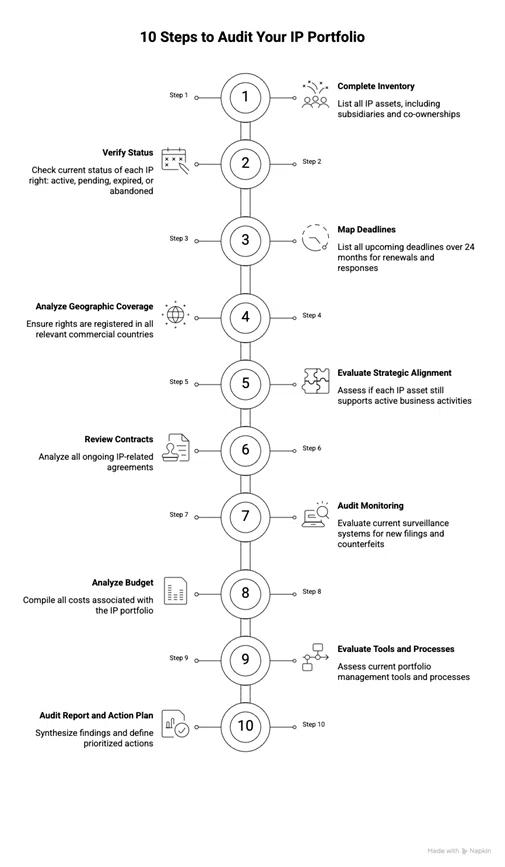
Third, the good news: it’s never too late to professionalize your IP management. Start with the 10-step audit described in this article, identify your most urgent vulnerabilities and evaluate available market solutions.
Migration to a dedicated tool typically takes 6 to 12 weeks. ROI is measurable within the first few months through time savings, secured deadlines and better strategic decisions.
Ready to take action? Schedule a free 30-minute personalized demo with an IPZEN expert. We’ll analyze your current portfolio together and show you how to centralize it in less than 4 weeks.
FAQ
What is IP portfolio management?
IP portfolio management refers to all activities related to administering, monitoring, renewing and optimizing a company’s intangible assets: trademarks, patents, designs, domain names and trade secrets. It aims to protect the value of these assets, ensure regulatory compliance and support the company’s business strategy.
How much does IP management software cost?
IP management software (IPMS) cost varies based on portfolio size, number of users and required features. SaaS solutions typically offer monthly or annual subscriptions. For an SME, expect 200 to 800 euros per month. For a large group with international portfolio, budgets can reach thousands of euros monthly. ROI is measured in missed deadlines prevented, administrative time saved and improved strategic decision quality.
What are the consequences of a missed deadline?
Consequences vary by right type. For a trademark, non-renewal triggers cancellation and monopoly loss – the sign becomes available to others. For a patent, non-payment of annuities causes lapse: the invention enters the public domain. In both cases, restoration is sometimes possible (grace period, appeals) but is costly, uncertain and time-limited.
When should I switch from Excel to dedicated software?
Migration to dedicated tools becomes essential when portfolios exceed 50-100 assets, when multiple people manage IP, when deadlines become hard to track manually, or when management demands regular reliable reporting. Earlier migration reduces error risk.
How can intellectual property be a financing lever?
Intellectual property can serve as collateral for financing and is valued during fundraising and due diligence audits. A well-managed and documented IP portfolio strengthens company credibility with investors and lenders.
What’s the difference between IP software and an IP counsel firm?
They’re complementary, not competitive. An IP counsel firm (like a patent agent or specialized law firm) brings legal expertise: filing strategy, claim drafting, litigation, oppositions. IP management software brings infrastructure: data centralization, deadline tracking, reporting and automated monitoring. Software doesn’t replace human expertise – it provides the data needed for better decisions. This is why many IP-specialized law firms use IPMS themselves to manage client portfolios.
About IPZEN: IPZEN is a SaaS platform for intellectual property management enabling companies and law firms to centralize, monitor and optimize their trademark, patent and domain name portfolio.
Ready to professionalize your IP management? Schedule a free 30-minute personalized demo with an IPZEN expert. We’ll analyze your current situation together and show you how to centralize your portfolio in less than 4 weeks. Book my free demo
Last updated: March 2026. This article is regularly revised to reflect regulatory and technological developments in the industry.