
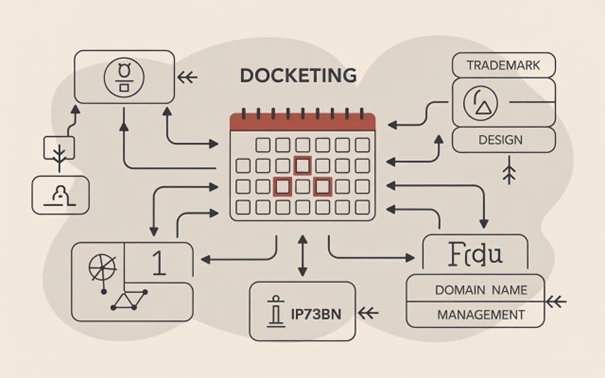
Managing intellectual property deadlines is essential to protecting trademarks, patents, designs, and related agreements. In many organisations, this management is still fragmented, partially documented, or handled with tools that were not designed for legal deadlines.
IP docketing, a structured process dedicated to managing deadlines, transforms this administrative constraint into a governance and risk-prevention system.
IP Offices regularly publish rules and procedural timelines, but I do not know of any verified statistics on how many rights are lost each year due to missed deadlines.
This guide explains:
- what IP docketing actually is,
- why it has become strategically important,
- how organisations can structure their internal processes,
- how a professional solution like IPZEN provides a more reliable and coherent framework than general internal tools.
Understanding IP docketing: definitions and key issues
IP docketing includes all processes, methods, and tools used to record, track, and anticipate deadlines affecting intellectual property rights.
Offices such as INPI, EUIPO, and WIPO publicly publish the official timelines applicable to filings, renewals, oppositions, office actions, and annuity payments. These are available on their respective websites.
IP docketing includes:
- recording all dates generated during filings and procedures,
- tracking deadlines to respond to Office communications,
- controlling renewals,
- documenting past and upcoming actions,
- coordinating internal teams and external representatives.
Companies operating across multiple jurisdictions must manage different legal rules.
The risks of missing a deadline exist, but I do not know how to quantify them precisely.
Why IP docketing is now essential
Reducing legal risk
Each Office has its own procedural timelines. These timelines are publicly available and must be verified at the source.
A docketing system improves traceability. I do not know how many companies lose rights due to missed deadlines, as no public source provides exact data.
Strengthening internal governance
Docketing provides structure: unified processes, centralised information, consistent workflows for legal, innovation, and marketing teams.
Improving visibility
Docketing provides clarity on upcoming deadlines across all jurisdictions. Offices publish their own timelines, but they do not provide consolidated multi-country views.
Supporting long-term IP strategy
A portfolio with reliable data can be analysed, rationalised, and optimised. Decisions are made in advance rather than in reaction to last-minute deadlines.
Limits of internal tools for managing IP deadlines
Many organisations rely on spreadsheets or generic project-management tools.
These approaches show several structural limitations:
- no automatic updates based on official rules,
- risk of human error in manual data entry,
- difficulty managing multi-jurisdiction timelines,
- lack of traceability when teams change,
- no structured historical record.
I do not know whether internal tools always lead to errors; this depends on the organisation.
However, these methods generally become insufficient once the portfolio grows or becomes international.
Best practices for effective IP docketing
Standardise data collection
Base information must be entered consistently: filing date, official number, owner, representative, status.
Document each action
A clear and accessible history is essential. Any user should be able to understand the context of a file.
Verify deadlines with official sources
The only verifiable sources for legal timelines are the Offices themselves:
- INPI: inpi.fr
- EUIPO: euipo.europa.eu
- WIPO: wipo.int
Establish a structured alert system
Alerts should follow levels (pre-alert, alert, urgent deadline). This reduces dependence on manual checks.
Conduct regular audits
A semi-annual or annual audit improves accuracy and consistency.
I do not know whether audits guarantee that no errors remain; Offices do not publish such guarantees.
How IPZEN strengthens your internal organisation
This section complements the service page by focusing on the added value, not the functional description.
A coherent methodological framework
IPZEN provides a structured environment: uniform fields, chronological ordering, consistent rules.
Full centralisation
Assets, documents, deadlines, notes, and statuses are accessible in a single, secured interface.
Integrated compliance
IPZEN is hosted in Europe in a GDPR-compliant environment. This is verifiable through IPZEN’s technical documentation.
Professional support
IPZEN is not only a software platform; it includes human guidance to support internal teams.
Practical example: managing a multi-jurisdiction portfolio
Illustrative example without unverifiable claims:
A company active in several countries manages trademarks at the INPI, EUIPO, and multiple national Offices.
Each Office applies different rules, leading to an irregular and difficult-to-anticipate timeline.
A structured docketing system provides:
- a consolidated calendar,
- reduced manual workload,
- clearer communication between subsidiaries,
- a more coherent documentary history.
I do not know the exact time or cost savings, as these depend on the initial situation and portfolio size.
Frequently asked questions about IP docketing
Do you need a large portfolio to justify docketing?
There is no official threshold. The relevance depends on the number of jurisdictions and procedural deadlines involved.
Is docketing purely administrative?
No. Deadline management affects strategy, budgeting, and legal risk.
Is a spreadsheet enough?
I do not know in which cases it might be sufficient. Internal tools depend on the organisation’s needs, but they usually show limits when multiple countries are involved.
How can a deadline be verified?
Only the responsible Office can provide the official timeline: INPI, EUIPO, WIPO, or a national Office.
Conclusion
IP docketing is a central component of intellectual property management.
It improves accuracy, strengthens governance, and supports long-term protection strategies.
When a portfolio becomes complex or international, a professional solution like IPZEN becomes a natural complement to internal processes by providing a structured, secure, and consistent framework.
Discover our all-in-one intellectual property management software.