
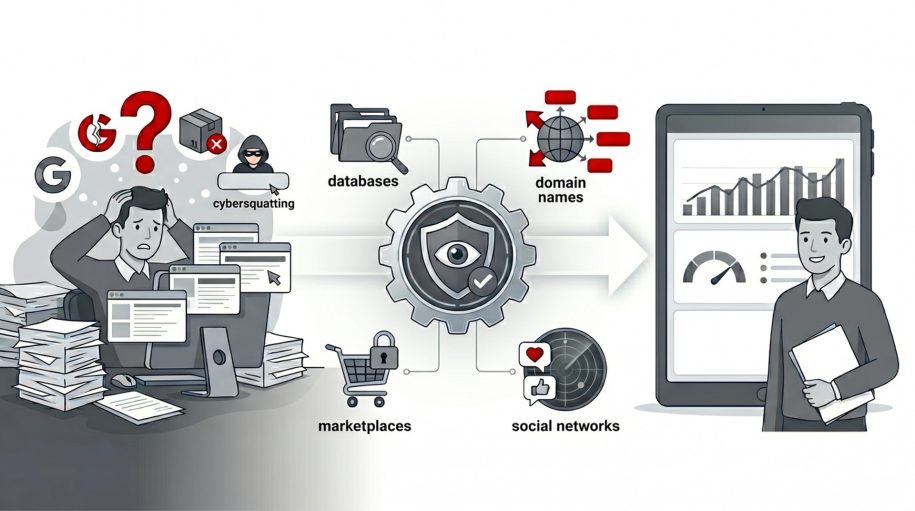
Setting up a trademark monitoring system isn’t a one-time task – it’s the foundation of effective brand protection. Without systematic monitoring, counterfeits slip past you, domain squatters claim your variations, and competitors chip away at your brand value. This checklist transforms trademark monitoring from a reactive scramble into a proactive, organized process that catches threats early and gives you the evidence you need to act fast.
Whether you’re protecting a single iconic mark or managing a portfolio of hundreds, this guide walks you through every step needed to build a monitoring system that actually works.
Quick summary: This 10-step checklist builds a complete trademark monitoring system in 2-3 weeks. You’ll audit your portfolio, define your scope, set up databases and alerts, configure marketplace monitoring, establish response protocols, and select tools. Estimated reading time: 12 minutes.
Step 1: audit your current trademark portfolio
Before you can monitor effectively, you need to know exactly what you’re protecting. Start by documenting every trademark you own or manage – not just the ones you’ve officially registered, but also pending applications, common law marks, and critical unregistered brands.
Create a master inventory spreadsheet that includes: the mark itself (word, logo, or combination), registration numbers, filing dates, renewal dates, jurisdictions, classes (using the Nice Classification), current status (registered, pending, abandoned, expired), and commercial use. This becomes your single source of truth. Many brands discover they’ve let valuable registrations lapse simply because no one centralized this data.
Your portfolio inventory directly feeds your monitoring scope. You can’t protect what you don’t know you own. This step also reveals gaps – markets where you should have registered but haven’t, classes where unregistered marks need legal coverage, or legacy marks that are no longer strategic.
Link this inventory to your trademark portfolio management system so it stays current. If you’re juggling multiple trademarks across jurisdictions, synchronize this with your IP docketing records.
Quick action: Spend 30 minutes pulling together your trademark registration certificates, pending applications, and any internal brand guidelines. Create a simple table with columns for mark name, registration number, jurisdiction, classes, renewal date, and status.
Pro tip: Some brands forget about well-protected marks registered 10+ years ago under old company names or subsidiaries. Check your domain registration records, old contracts, and trademark assignment files. These sleeping marks can still protect you if actively monitored.
Step 2: define your monitoring scope
You can’t monitor everything everywhere. Smart monitoring starts with strategic scope boundaries. Decide which jurisdictions matter most (U.S., EU, China, ASEAN, Japan?), which product classes align with your business model, which digital channels pose the biggest risk to your brand, and which geographic markets are highest priority for growth or vulnerability.
Many brands use a tiered approach: Tier 1 includes core markets and essential classes (where you invest in comprehensive monitoring). Tier 2 covers secondary markets and adjacent classes (lighter monitoring). Tier 3 is opportunistic (monitoring only when a threat surfaces). This prevents alert fatigue while keeping watch where it matters most.
Your scope should also address digital channels: e-commerce marketplaces (Amazon, eBay, Alibaba), social platforms (Instagram, TikTok, Facebook), search engines, and the dark web if counterfeiting is a serious problem. Unregistered trademark uses online often trigger faster enforcement than physical goods.
Use the Nice Classification system to translate “what we sell” into watchable trademark classes. Class 25 (clothing), Class 09 (software), Class 35 (retail services) – make sure your monitoring covers the classes where you’re actually vulnerable.
Quick action: List your top 5 countries by revenue, top 3 countries by counterfeiting risk, and top 2 adjacent markets you’re entering. Map these to the Nice Classification classes that matter to your business. This is your Tier 1 scope.
Pro tip: Many counterfeiting operations begin in tier 2 or tier 3 markets before spreading to your core jurisdictions. Don’t ignore secondary markets entirely – set a quarterly alert review for expansion risks.
Step 3: identify your high-priority marks
Not all trademarks need equal monitoring intensity. Some generate millions in revenue; others are legacy marks. Some are famous and easily confused; others are niche and defensible only locally. Identify your high-priority marks using a scoring framework.
Score each mark on four dimensions: revenue impact (does this mark directly drive sales or licensing?), brand recognition (how familiar are customers?), strategic value (is this your flagship brand, a sub-brand, or a product line?), and vulnerability (how often is it imitated, diluted, or misused?). High-scoring marks get comprehensive monitoring; lower-scoring marks get lighter coverage or periodic reviews.
This is where honest assessment helps. Your iconic brand gets 24/7 monitoring across Tier 1 markets. Your emerging brand gets daily monitoring in growth markets but weekly reviews elsewhere. Your legacy brand gets quarterly audits unless infringement patterns emerge.
Create a simple scoring matrix (1-5 scale per dimension) and calculate an overall priority score. Marks scoring 16+ get your most aggressive monitoring; 12-15 get standard monitoring; below 12 get quarterly reviews. Revisit this annually as your business evolves.
Quick action: Take your top 10 marks and score them quickly on revenue impact, recognition, strategic value, and vulnerability (1-5 scale each). Marks scoring 15+ are your monitoring priority.
Pro tip: A single viral counterfeit product or social media impersonation can turn a low-scoring mark into a priority overnight. Build flexibility into your monitoring so you can escalate marks if new threats emerge.
Step 4: set up trademark database monitoring
Trademark offices worldwide publish new applications and registrations every single day. If a competitor or counterfeiter applies for your mark, you may have weeks to oppose before registration. But you’ll only catch it if you’re watching.
Set up monitoring across:
- National trademark offices: USPTO (U.S.), EUIPO (Europe), WIPO (international)
- WIPO Global Brand Database: consolidated database covering 50+ jurisdictions
- TMview: free unified search tool covering 80+ national and international trademark offices
- EUIPO eSearch: European trademark database with daily updates
- Regional offices: ASEAN Trade Mark and Design Office (Thailand), China Trademark Office (CIPO), Japanese Patent Office (JPO)
Most offices offer official monitoring services. The USPTO’s Trademark Official Gazette, for example, lists new applications and registrations daily. WIPO allows email alerts on applications matching your marks. EUIPO has the eWatch alert system.
Free tools like TMview require manual searches, but paid trademark watch services automate this entirely, emailing you daily or weekly when similar marks are filed.
Build a checklist of the specific trademark databases your business needs to monitor based on your Tier 1 and Tier 2 scope. Include renewal deadlines – missing a renewal puts your mark at risk for cancellation.
Quick action: Visit TMview (https://www.tmdn.org/) and search for your top 3 marks. Save the URLs. Then check if your national trademark office offers official watch services – most do.
Pro tip: Similarity searches on trademark databases aren’t perfect. Hire a specialist to run phonetic and conceptual searches (not just exact matches) for your priority marks. A competitor might file “Acmee” instead of “Acme” and still create confusion.
Step 5: configure domain name monitoring
Domain names and trademarks are inseparable in modern brand protection. Cybersquatters register your mark as a domain (yourmark.com, yourmark.io, yourmark.cn) or typo-squat variations (yormark.com, yurmark.com) and either monetize the traffic or use it for phishing and counterfeiting.
Set up domain monitoring for:
- Exact-match variations: your mark plus common TLD variations (.com, .net, .org, .co, .io, .app, .shop, and country-code TLDs like .de, .jp, .cn)
- Typo squatting patterns: common misspellings, transpositions, and homophone substitutions
- Prefix and suffix additions: “buy-yourmark.com,” “yourmark-shop.com,” “yourmarkfr.com” (for France)
- Brand TLD registrations: if you own a brand-specific TLD (like .yourmark), monitor any registrations in that TLD
Use automated domain monitoring tools like DomainTools, Whois monitoring services, or integrated IP management platforms. Set alerts for new registrations and WHOIS changes. ICANN’s WHOIS lookup service and regional registrars provide the baseline data; automated tools check it daily.
Link domain monitoring directly to your domain name monitoring strategy. Track which domains are registered, who owns them, what content they host, and whether they pose a real threat. Many typosquatted domains are parked and harmless; others are actively selling counterfeits or running phishing campaigns.
Quick action: List 5-10 common typosquatting variations of your main mark (common misspellings, transpositions, homophones). Check if they’re already registered using your favorite WHOIS lookup tool. If yes, note the registrant and IP address for follow-up.
Pro tip: WHOIS privacy is standard now, but registrars (like GoDaddy, Namecheap) keep detailed records and will share them with trademark holders during UDRP disputes. Don’t assume an anonymized domain is unrecoverable – it usually is if the activity is clearly infringing.
Counterfeiting and brand abuse thrive on e-commerce platforms and social media. Amazon, eBay, Alibaba, Shopify, and social networks (Instagram, TikTok, Facebook) are where most consumers encounter fake versions of your brand.
Set up monitoring and reporting tools:
- Amazon Brand Registry: Protects your brand on Amazon with automated enforcement tools. If eligible, enroll immediately.
- eBay VeRO (Verified Rights Owner): File infringement reports and request listing removals directly.
- EUIPO E-Enforcement: centralized submission system for removing counterfeit goods across European marketplaces.
- Facebook/Instagram Brand Monitoring: Meta’s IP reporting system flags and removes infringing content.
- TikTok IP Protection: TikTok’s IP reporting system for counterfeits and brand abuse.
- Alibaba IP Protection Center: Alibaba’s reporting system for counterfeiting and trademark abuse.
- Google Trademark Complaint System: Report unauthorized use in Google Search ads and Shopping results.
Assign someone (or a team) to review marketplace alerts weekly. Many platforms require evidence of trademark registration, so keep PDFs of your certificates handy. Fast action wins – a fake product can spread to dozens of sellers in weeks if not caught early.
Create templates for reporting to each platform. Know the evidence you need (registration certificates, proof of use, comparison photos) before you need to report something urgent.
Quick action: If you sell on Amazon, eBay, or Alibaba, enroll in their respective brand protection programs today. Download your registration certificates and create a simple one-page template for submitting counterfeiting reports.
Pro tip: Counterfeiters often reappear under new seller accounts after removal. Keep a running log of which sellers, accounts, and warehouse addresses are repeat offenders. Pattern evidence strengthens UDRP cases and helps platforms issue permanent bans.
Step 7: establish alert thresholds and escalation protocols
Raw alerts are useless without a framework for deciding what matters. Define alert thresholds – which findings trigger immediate action, which need review, which are informational only. This prevents alert fatigue and ensures fast response to real threats.
Create a severity table:
| Severity | Criteria | Response | Timeframe |
|---|---|---|---|
| Critical | Active counterfeiting, phishing, brand impersonation, major marketplace listings, trademark office opposition to your mark | Immediate escalation to legal team, law enforcement notification, cease & desist | 24-48 hours |
| High | Marketplace listings of suspicious goods, domain registrations by unknown parties, social media accounts using your name, similar marks filed in Tier 1 markets | Review and investigative action | 1 week |
| Medium | Similar marks filed in Tier 2 markets, domain registrations by known brands, low-quality counterfeit listings | Quarterly assessment and strategic response decision | Monthly review |
| Low | Informational alerts (trademark publications, minor variations), domain parking pages with no content | Archive and monitor for escalation | Quarterly |
Define who makes escalation decisions: your IP team, legal department, brand team, or C-suite? Most organizations use a team approach – the IP specialist triages, legal makes enforcement decisions, the brand team assesses market impact.
Set response SLAs (service-level agreements). “Critical alerts require legal review within 24 hours.” “High-priority domains flagged to our IP team within 48 hours.” Clear SLAs keep everyone accountable.
Document your escalation process in a simple flowchart: Alert received → Triage (is it real?) → Severity assessment → Escalation to the right owner → Action decision → Execution → Follow-up.
Quick action: Draft a one-page severity matrix for your business. What’s critical to you – counterfeiting, domain squatting, or brand dilution? Define what “critical” looks like and who owns the response.
Pro tip: Some alerts are false positives – a business legitimately named “Acme Tech Services” isn’t necessarily infringing your “Acme” trademark. Train your triage team to ask: Is there a likelihood of confusion? Is this commercial use? Are they in a competing class? This saves time on non-issues.
Step 8: define your response playbook
When you find infringement, what do you do? A clear playbook eliminates guessing and keeps responses consistent. Document your response options for different threats.
Cease and Desist Letters: Formal demand to stop infringing activity. Low-cost, first-line response. Works for many online listings and small operations. Requires evidence of infringement and your intellectual property rights.
Trademark Office Opposition and Cancellation: If someone files an identical or confusingly similar mark, you have months to oppose at the trademark office before they register. Cancellation (removing an already-registered mark) is harder but possible if disused for 3-5 years (varies by jurisdiction).
UDRP (Uniform Domain-Name Dispute-Resolution Policy): For cybersquatted domains. File a complaint with ICANN-approved arbitrators. Costs $1,500-3,000 but recovers domains faster than litigation. Requires proof of bad faith registration.
Negotiation and Settlement: For legitimate business conflicts. Maybe a company has a similar name but operates in a non-competing class – negotiation clarifies boundaries.
Litigation: For serious, ongoing counterfeiting or brand dilution. Expensive but necessary for protecting brand reputation and stopping systemic operations.
Social Platform Reporting: Abuse reports to Meta, TikTok, Google, and others – fast, free, and often effective for removing impersonation accounts and infringing ads.
Create a simple decision tree:
- Is it a domain? → UDRP path
- Is it an online listing (Amazon, eBay)? → Platform reporting path
- Is it a pending trademark application? → Office opposition path
- Is it an existing trademark registration? → Cancellation path (slow) or coexistence agreement
- Is it social media/content? → Abuse reporting path
- Is it systematic counterfeiting? → Cease & desist + law enforcement
Train your team on evidence collection for each path. UDRP cases need domain registration proof and timeline. Cease & desist letters need side-by-side trademark comparisons. Litigation needs customer confusion evidence and sales impact.
Quick action: For your top 3 marks, write out: “If we find a counterfeit, our first action is [cease & desist / UDRP / platform reporting].” This clarifies your immediate response.
Pro tip: Many enforcement decisions depend on cost-benefit analysis. A single $50 counterfeit listing probably doesn’t justify a $5,000 lawyer’s cease & desist. Establish a dollar threshold (“we pursue anything representing $X+ of potential sales impact”) and stick to it.
Step 9: set up reporting and review cycles
Monitoring generates alerts. Alerts require reviews. Reviews need to be scheduled or they get forgotten. Build a regular reporting and review calendar.
Monthly operational reviews: 30 minutes with your monitoring team. How many alerts came in? How many were acted on? Any patterns emerging? Are there tools or databases that aren’t working? This is the “execution rhythm.”
Quarterly strategic reviews: 1-2 hours with your IP and brand teams. Are there new markets or product lines to add to your scope? Are any marks proving more vulnerable than expected? Should priority scores be updated? Are certain counterfeiters or cybersquatters becoming repeat problems? This is where you adjust your strategy.
Annual portfolio audit: Comprehensive review with legal counsel. Are we monitoring the right marks? Have we missed any? What enforcement actions actually worked? What was the return on investment? Should we file defensive registrations or abandon marks? This informs next year’s strategy.
Create a simple monitoring dashboard that tracks:
- Number of alerts by month
- Number of actions taken (cease & desist, UDRP filings, platform reports)
- Success rate (how many threats were resolved favorably?)
- Cost per action
- Enforcement outcomes (how many were withdrawn, settled, or litigated?)
These metrics tell you whether your monitoring system is working and where to focus resources next.
Link regular reviews to your deadline tracking system. Renewal deadlines, action deadlines, and review dates shouldn’t slip. Many brands lose enforcement leverage because their IP team missed a 30-day response window.
Quick action: Block 30 minutes on your monthly calendar for “trademark monitoring review” and 2 hours quarterly for “strategic IP review.” Add these recurring events to your team calendar now.
Pro tip: Some brands create a “Monitoring Scorecard” each quarter: X alerts received, Y actions taken, Z resolved. This builds support for continued monitoring investment and shows stakeholders that the system is delivering value.
Step 10: choose the right monitoring tools and partners
You can monitor in-house, outsource to specialists, or use a hybrid approach. Each has tradeoffs.
In-house monitoring: Your team manually searches trademark offices (free), subscribes to official watch services (low cost), monitors domains (low cost), and watches marketplaces (labor-intensive). Good for small portfolios, close brand control, lower cost. Requires ongoing team time and expertise.
Outsourced (trademark watch service): Specialists monitor for you, compile alerts, and recommend actions. Costs $200-2,000+ per mark per year depending on scope and jurisdiction. Good for large portfolios, specialized expertise, consistency. Less hands-on control.
Hybrid: In-house team monitors core jurisdictions and high-priority marks; outsource secondary markets and low-priority marks. Balances cost and control.
Choose software and tools based on your scope:
| Feature | Tool | Notes |
|---|---|---|
| Trademark database monitoring | USPTO Official Gazette, WIPO Global Brand Database, TMview, EUIPO eSearch | Free but require manual review. Paid watch services automate this. |
| Domain monitoring | DomainTools, DNSomewhere, Whois monitoring services | Automated daily checks, cost $100-500/year for small businesses. |
| Marketplace monitoring | Amazon Brand Registry, eBay VeRO, Alibaba IP Center, specialized monitoring services | Platform tools are free (Amazon Brand Registry requires enrollment). Paid services $500-2,000/year. |
| IP management platform | IPZEN, CMS (Clarivate), Thomson CompuMark, Anaqua | All-in-one solutions if you manage 100+ marks. Cost varies with portfolio size. |
Evaluate tools on: coverage (does it monitor your jurisdictions?), accuracy (does it catch real threats or generate false positives?), integration (does it fit your workflow?), cost (per-mark, per-year, or per-action pricing?), and support (can you reach specialists when you need them?).
Quick action: For your current portfolio size, research 2-3 monitoring tools or services. Compare pricing for your specific scope. Budget realistic costs into your annual IP plan.
Pro tip: Tool cost should be weighed against enforcement cost. If monitoring helps you catch one serious counterfeiting operation before it scales, the return far exceeds the tool’s annual subscription. Frame it as prevention, not expense.
your monitoring system is ready
You’ve now built a complete trademark monitoring system – from portfolio audit to escalation protocols to tools. You have clarity on what you’re protecting, where threats are most likely, what action you’ll take when you find them, and the tools to catch threats early.
This system evolves. Markets shift, threats emerge, tools improve. Revisit your scope annually, your priority scores quarterly, and your escalation playbook whenever enforcement approaches change. The brands that lose trademark protection aren’t the ones with great marks – they’re the ones that stopped monitoring, stopped reviewing, and let threats grow silently.
Starting this week, execute each of these 10 steps in order. By week 3, your monitoring system will be operational. By month 2, you’ll see patterns in where threats come from and can optimize your focus. By month 6, you’ll have enforcement wins that prove the system works.
FAQ
What’s the difference between trademark monitoring and domain monitoring?
Trademark monitoring watches for new trademark applications and registrations at trademark offices. Domain monitoring watches for new domain registrations that might infringe your mark. Both are essential – a brand can be protected at the trademark office but still lose the .com domain to a cybersquatter, or lose customers to a typo-squatter site. Monitor both.
How often should we check for infringement?
Ideally, automated daily. Manually, at least weekly for high-priority marks and Tier 1 markets, monthly for secondary marks. Daily monitoring catches threats before they scale – a new counterfeit listing removed in 24 hours stays small; left alone for a week, it reaches hundreds of customers. Automation is worth the cost.
Can we monitor everything ourselves, or do we need a service?
If you own fewer than 10 marks, in-house monitoring is feasible and saves cost. Assign someone 2-3 hours per week to manual searches. As your portfolio grows past 20-30 marks, efficiency gains from professional services become clear – specialists catch threats your team might miss and handle repetitive searches faster. Most growth-stage companies use a hybrid: in-house for core marks, outsourced for secondary markets.
What evidence do we need to enforce trademarks we find infringed?
For cease & desist: your registration certificate, proof of use (marketing materials, sales records), side-by-side comparison of marks showing likelihood of confusion, and evidence of their commercial use. For UDRP: your trademark registration and evidence of bad faith registration (domains registered shortly before your mark became famous, or after your company acquired market prominence). For platform enforcement: your registration certificate and proof that the listing/account directly infringes. Collect evidence as you find threats, not after you’ve decided to enforce.
Should we file defensive trademark registrations?
For well-known brands vulnerable to alternative spellings, homophone substitutions, or brand dilution, yes – defensive registrations in different classes or geographic markets strengthen enforcement. A famous brand like “Apple” might register “Apple” in dozens of classes even if they don’t operate in all of them – this prevents others from registering “Apple” in those classes and claiming non-use defenses. Consult a trademark attorney on your specific situation, but defensive filings are common for high-value brands.
About IPZEN: IPZEN is a SaaS platform for intellectual property management enabling companies and law firms to centralize, monitor and optimize their trademark, patent and domain name portfolio.
Schedule a free demonstration to see how IPZEN automates trademark monitoring for your portfolio.
Manage your domains with our domain name management software.