
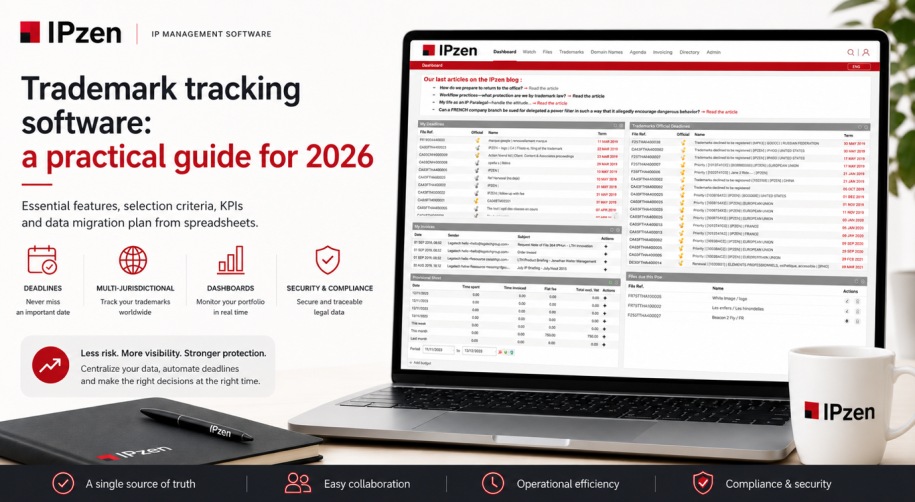
Around 65,000 international trademark applications are filed each year through the Madrid System administered by WIPO, and the active records under management across the major IP offices, EUIPO, USPTO, UKIPO and others, run into the millions. These macro figures translate, at the level of a single firm or in-house team, into portfolios of fifty, five hundred or several thousand titles to track. For any organisation that depends on its brand assets, law firms, in-house IP departments or exporting SMEs, the operational reality is the same: tracking dozens, hundreds or thousands of titles spread across multiple jurisdictions, with deadlines that never stop arriving.
The spreadsheet is no longer enough. Not because of any technological inadequacy, but because it does not absorb the cognitive load: forgotten renewals, stale status records, duplicated data, manual handovers between team members. For strategic trademarks, the cost of losing priority through a missed renewal often exceeds the annual investment in dedicated software.
This guide describes what a modern trademark management software should do, how to assess the maturity of your current tracking, which criteria genuinely differentiate solutions on the market, and how to migrate successfully from an internal tool. It is written for the decision-makers who have to make the call on an IP software investment.
What we mean by trademark management software
The term covers a broader scope than most assume. A trademark management software is a platform that consolidates, in a single place, all information related to a trademark portfolio: titles, official statuses, deadlines, ongoing procedures, related documents, invoices, and any data needed to run the portfolio operationally and strategically.
It should be distinguished from several adjacent tools. A watch service scans new filings to detect conflicts. A clearance search tool checks the availability of a mark before filing. A document management system stores files but does not track lifecycle events. A trademark management software integrates some or all of these functions, but its primary role is to govern the existing portfolio over time.
For law firms, the tool also structures the client relationship: dedicated portal, automated reporting, integrated billing. For in-house departments, it serves as a single source of truth for executive management, business units and external counsel.
The six core functions of professional trademark management software
Not every product on the market carries the same scope. To qualify as a professional trademark management software, a platform should deliver six functions at operational depth.
1. Portfolio data centralisation
Every piece of information about a title, from filing to renewal, should be accessible in one place. This includes registry numbers, Nice classes, jurisdictions, owners, agents, procedural history, PDF documents and related billing. Without this centralisation, the efficiency loss repeats every time a client report is needed.
2. Official status tracking (WIPO, EUIPO, USPTO, UKIPO and national offices)
A title’s status evolves constantly : examination, publication, opposition, registration, dispute, renewal. A professional platform synchronises statuses with the databases of national and international offices. Most major offices now expose feeds or queryable databases. A platform’s ability to integrate these sources is what separates a modern tool from one still relying on manual entry.
3. Automated deadline and renewal management
Renewal deadlines, opposition windows, annual fees, office notifications : these dates structure the life of a portfolio. The agenda and deadline tracking function should not just remind users of dates. It should trigger workflows, route alerts to the right person, prepare associated documents, and trace the decision taken. This automation brings operational risk down to an acceptable level.
4. Tracking of oppositions, disputes and procedures
Each procedure (opposition, invalidity action, infringement litigation) has its own timeline, exhibits and exchanges. The platform should l et teams manage these as matters tied to the title, with a portfolio-wide view of active risks. This is what transforms a trademark portfolio from a record s et into governed legal subject matter.
5. Strategic reporting and dashboards
Reporting is what turns an operational tool into a governance instrument. A dashboard should give an immediate read on portfolio distribution by jurisdiction, class and owner, renewal rates, the age pyramid of titles, and active risk zones. For a firm, this reporting capability inside trademark portfolio management becomes a commercial asset in its own right, giving the client visibility they did not previously have.
6. Security, traceability and data sovereignty
Trademark portfolio data is strategic : it reveals innovation paths, target markets and competitive positioning. The software must meet sector-standard data security and governance: encryption, controlled hosting, access traceability, redundant backups, recognised certifications. Data portability in case of platform change should also be explicitly documented.
Auditing the maturity of your current tracking: five key questions
Before considering a software investment, it is useful to objectively assess the maturity of the current setup. Five questions deliver a fast diagnosis.
First, how long does it take to produce a current portfolio statement for a client or executive committee? If the answer exceeds half a day, the current system is sub-optimal.
Second, over the last twelve months, how many deadline alerts were triggered within the last seven days of the deadline? Beyond a handful, the alerting setup carries a structural risk.
Third, are portfolio records synchronised with the official status held by the offices? If updates rely on manual entry, the gap between the internal record and the office record is statistically guaranteed.
Fourth, how many team members access the same source file, and across how many divergent versions? Non-collaborative multi-user is one of the earliest symptoms of an in-house tool reaching its limits.
Fifth, if the paralegal or partner responsible for the portfolio leaves, how many days would it take to reconstruct the management history? This question exposes the actual level of structure in the tracking process.
If three out of five answers are unsatisfactory, the organisation is ready to move to professional software.
Selection criteria for trademark management software
The market offers solutions that differ widely in scope, functional depth and commercial model. Five criteria structure an informed choice.
Jurisdictional coverage and integration with official databases
The ability to cover the jurisdictions in which your portfolio sits is the first criterion. For a European firm, integration with EUIPO, the Madrid System and major national offices is generally the minimum baseline. International organisations will add USPTO, UKIPO, JPO and the key offices of their target markets. Check the integration mode (API, webhook, scheduled sync) and update frequency.
Functional depth vs ease of use
Exhaustive but complex software will be under-used. Simple but incomplete software will create workarounds. The balance is measured at the operational team level: if an experienced paralegal is not autonomous after one day of training, the interface is too complex; if the platform fails to expose half of the necessary functions, the tool is under-sized.
Pricing model and scalability
Three pricing models dominate : by number of titles, by user, or tiered flat fees. Each suits a different profile. For a growing portfolio, check the marginal cost of an additional title. For an expanding team, check the relevance of the per-user model. A free trial or a pilot period helps calibrate the right model before long-term commitment.
Security, hosting and compliance
European hosting has become a structural criterion for organisations subject to GDPR and for sensitive clients. Verify vendor certifications, dual-datacentre redundancy, backup frequency, encryption in transit and at rest, and the depth of access traceability. The ability to produce a security audit report on demand is a sign of maturity.
Quality of support and vendor roadmap
A platform is bought on a multi-year horizon. Support quality, time zones covered, frequency of functional updates, and the existence of a public or semi-public roadmap are all indicators of investment longevity.
Migrating from spreadsheets: a six-step transition plan
Migration from a spreadsheet or in-house tool is what determines project success. It typically unfolds in six steps over four to eight weeks.
- Step 1 — source data audit. Inventory every field present, its completeness rate, inconsistencies across files, and zones of uncertainty. This audit drives everything that follows
- Step 2 — cleansing and harmonisation. Align labels, correct statuses, verify key dates. Poor cleansing at this stage costs double during configuration
- Step 3 — target platform configuration. Define user roles, workflows, document templates, alerting rules. The vendor should co-pilot this step
- Step 4 — import and reconciliation. Load the data, sample-check correspondence with the source, correct discrepancies. A 100 percent reconciliation is rarely achievable at first; target 98 percent and document the exceptions
- Step 5 — parallel run over four to six weeks. Maintain both systems concurrently, verify that alerts fire on time and that statuses update correctly. This phase reassures the team and surfaces fine-tuning needs
- Step 6 — cutover and decommissioning. Once the parallel run is validated, retire the source tool, archive historical versions, and communicate internally and with external counsel.
KPIs to measure trademark tracking performance
Once the platform is live, four indicators frame governance
- Deadline compliance rate — percentage of deadlines handled before D-15. A mature setup exceeds 95 percent
- Average status update lag — time elapsed between an office notification and the corresponding update in the platform. On a well-integrated platform, this lag is measured in hours, not days
Average time to produce a client or executive report: with structured software, this drops below one hour for standard reports, compared to half a day to a day under manual operations.
Document coverage rate : percentage of titles with key documents available in the platform (filing certificate, registration certificate, office correspondence). A realistic six-month target is 90 percent.
An anonymised case: structuring trademark tracking for a European industrial group
A French industrial group operating across eight European countries, managed a portfolio of 1,400 trademarks across EUIPO, the Madrid System and several national offices. Tracking relied on two parallel spreadsheets maintained by two different paralegals, a legacy document management system, and manual chasing of renewals via an external agent.
An internal audit in 2024 found that nearly 4 percent of annual deadlines had been handled within the last seven days of the window, of which two titles had been abandoned for lack of timely decision. The direct cost of these abandonments, in refiling and loss of priority, alone justified the investment in a platform.
Migration ran over six weeks. Six months after cutover, the deadline compliance rate exceeded 98 percent, the production time for the quarterly report to the legal department had dropped from four days to half a day, and the team had absorbed an extension of the portfolio into two new jurisdictions without additional headcount. The direct ROI, measured over the first twelve months, exceeded the licence cost.
Frequently asked questions
What is the difference between trademark management software and a watch service?
Trademark management software runs the lifecycle of your portfolio: statuses, deadlines, renewals, procedures, documents. A watch service scans new filings to detect marks likely to conflict with yours. The two are complementary. Advanced platforms integrate both functions in a single environment, which avoids fragmenting strategic information across tools.
At what portfolio size does dedicated software become necessary?
The operational threshold is usually between 50 and 100 active titles. Below that, a disciplined spreadsheet can work if backed by a reliable alert system. Beyond that, the risk of missed deadlines or data entry errors becomes statistically significant, and the cost of a single lost title typically exceeds the annual investment in professional software.
Can a tracking platform be combined with an outsourced docketing service?
Yes, and it is a common pattern. The platform serves as the single repository for internal teams, while outsourced docketing adds a second layer of verification on deadlines through a specialised provider. The condition is that the platform supports a reliable integration or export flow to keep both sources in sync.
How long does it typically take to migrate from a spreadsheet to professional software?
For a portfolio of a few hundred titles, migration usually takes between four and eight weeks. The duration depends mainly on the quality of the source data (field consistency, historical traceability, completeness) rather than on the target platform. A preliminary data audit is the investment that yields the most leverage on migration success.
How can data portability be guaranteed if I switch tools later?
Reversibility must be contractual. Confirm in the documentation and the agreement the availability of a full export in standard formats (CSV, JSON, ideally a structured export following WIPO ST.96 schemas), the financial conditions of that export and the timeline within which it is delivered on exit. Serious platforms document this portability explicitly.
Why IPzen
Built by IP professionals for IP professionals, IPzen is an integrated trademark management software that combines portfolio centralisation, official status tracking, deadline and docketing management, opposition tracking, client reporting and billing in a single environment.
The solution is used by law firms, IP practitioners, in-house IP departments and exporting SMEs in Europe and internationally. It runs on dedicated infrastructure hosted in Europe, with AES-256 encryption at rest and TLS 1.3 in transit, dual-datacentre redundancy and 24/7 monitoring. All processing is governed by a GDPR-compliant framework.
Take the next step
To see whether IPzen fits your tracking profile, the vendor offers a personalised demonstration and a free trial. The session is calibrated on your current portfolio and identifies the first measurable operational gains.
IPzen has been supporting law firms, IP counsel and corporate legal teams for over 15 years in the secure management of their intellectual property assets.
Go further with our IP docketing software.