
WIPO processed around 65,000 international trademark applications under the Madrid System in 2025. The volumes flowing through EUIPO, USPTO, UKIPO and other national offices follow the same pattern. The consequence for IP practices is immediate: more titles under management, more deadlines to monitor, more jurisdictions to coordinate, and rarely enough headcount to absorb the load.
In this context, talking about the automation of IP management is no longer a technology curiosity. It has become a structural question. And yet, many practices still frame automation as a productivity tool: fewer spreadsheets, a shared calendar, a slightly faster docketing process. That framing misses the point. The deeper shift happening inside the most advanced IP practices is a redefinition of what IP practitioners actually do. Less administrative work, more strategic counsel.
The new economics of IP practice
The IP profession sits at an unusual intersection. The legal complexity of the work keeps rising (cross-border enforcement, brand protection in the age of AI-generated content, governance of digital assets across hundreds of TLDs), while the commercial pressure on fees keeps tightening. Corporate clients are running procurement reviews on IP services. In-house teams are consolidating their external panels. Fixed-fee arrangements are spreading.
The natural conclusion is that the value of an IP practice can no longer come from the volume of administrative tasks it processes. It has to come from the strategic insight it delivers. That shift is impossible to make if the team is consumed by deadline tracking, renewal management and manual reporting.
This is why automation has moved from a back-office concern to a board-level decision.
What automation actually changes
It is tempting to define automation as the replacement of manual tasks by software. That definition is technically correct and strategically incomplete. The deeper change is structural.
Docketing and deadline management
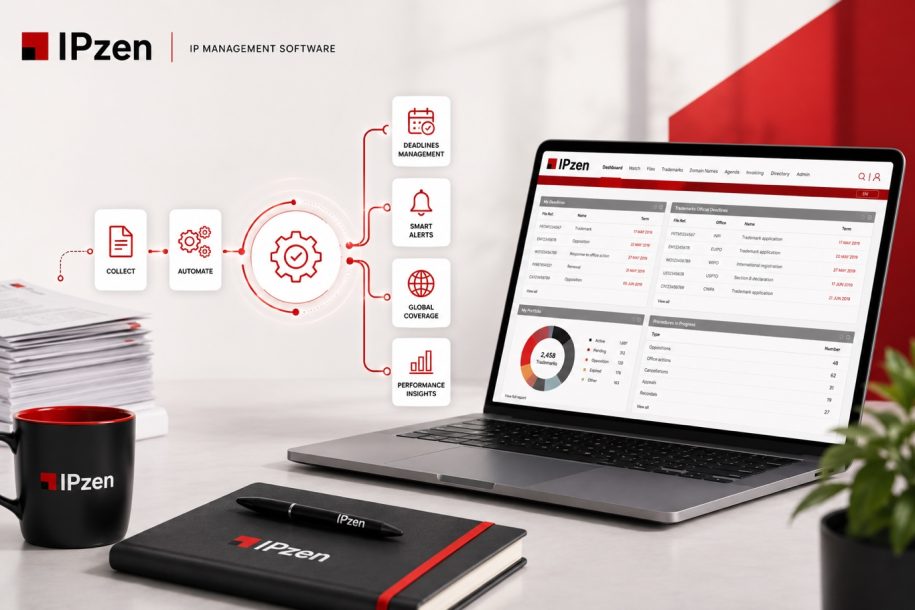
A manual docketing system protects against missed deadlines, but it does not protect against the cognitive cost of constantly checking it. A modern IP docketing platform, integrated with the major IP offices and with the firm’s internal workflow, removes that load entirely. IP practitioners stop running mental checklists. Paralegals stop reconciling spreadsheets. The deadline is no longer a thing to track. It becomes a thing the system handles, until human judgement is required.
Watching and surveillance
A traditional watch service produces alerts. A modern automated watching platform produces ranked, contextual notifications, filters out false positives, and integrates the actionable items directly into the case management system. IP practitioners never sees the noise. In a global portfolio context, this distinction often determines whether the practice can offer truly proactive monitoring or only reactive defence.
Portfolio steering and client experience
Modern trademark portfolio management platforms now offer client portals, automated reporting and integrated billing as a baseline. The real differentiator is no longer whether these capabilities exist, but how they are integrated: a portal disconnected from docketing, or billing that lives outside the case management system, recreates the very silos automation was supposed to eliminate.
From paperwork managers to strategic advisors
The most valuable IP practices in the next decade will not be those with the largest teams or the longest filing histories. They will be those that have successfully repositioned themselves as strategic advisors on the management of intangible assets.
This repositioning has direct implications. It means partners who advise corporate clients on the geographic prioritisation of their portfolios, who flag likelihood-of-confusion risks before opposition proceedings, who help startups structure their IP for an acquisition or fundraising. It means in-house counsel who can produce a board-level analysis of risk exposure across a global trademark portfolio in hours, not weeks. It means consultants who can offer benchmark insights drawn from real portfolio data, not anecdote.
None of this is possible without automation handling the foundational layer. The strategic conversation only happens when the administrative substrate is invisible.
The data dimension: from records to intelligence
There is a side effect of automation that most IP teams discover only after implementation. Every automated workflow generates structured data. Every filing logged, every opposition tracked, every renewal processed becomes a record. Aggregated across a portfolio or a practice, that data becomes intelligence.
Practices that operate on automated platforms can answer questions that used to require weeks of manual extraction. What is the average time to grant in jurisdiction X for our portfolio? Which of our clients have the highest exposure to opposition in classes 9 and 35? Where do our renewal fees concentrate? These answers transform the firm’s conversation with its clients, because they move it from anecdote to evidence.
There is, however, a precondition : the data has to remain under the firm’s control. The question of where information is stored, who can access it, how it is encrypted and whether it can be exported in the event of a platform change has become a board-level concern. Sophisticated clients increasingly expect their advisors to demonstrate not only legal competence but also robust data security and governance.
An anonymised case: scaling a mid-size IP practice
A European IP boutique with around a dozen partners and associates managed a portfolio of more than 8,000 titles across EUIPO, USPTO and the Madrid System. Until 2023, operations relied on three disconnected tools: an in-house docketing database, a billing spreadsheet and a legacy document management system. An internal audit estimated that nearly one third of paralegal time was spent on redundant data entry.
Moving to an integrated platform produced three effects within six months. First, eliminating double entry freed up time that was redeployed into proactive watching for client portfolios. Second, client reporting, previously monthly and manual, became available in real time through a dedicated portal, which strengthened the perception of transparency on the client side. Third, the consolidation of portfolio data revealed advisory opportunities the firm had not previously seen: strategic renewals to anticipate, under-protected classes in certain jurisdictions, weak signals of infringement in emerging markets.
The return on investment was not measured against the licence cost, but against the additional margin generated by the firm’s upmarket repositioning.
Building an automation roadmap that fits your practice
Successful IP automation rarely begins with software selection. It begins with a process audit. Every practice carries its own legacy of workflows, internal conventions and client habits. Automating a broken process produces a broken process at higher speed.
Three questions guide the audit. First, where do the same data points get re-entered? Each instance is an opportunity for error and a candidate for automation. Second, where does the practice depend on individual memory? If a single associate going on leave creates a knowledge gap that delays client work, the issue is not the associate. It is the absence of a system that captures the work. Third, what would the practice do differently if its team had 30 percent more time? The answer often reveals the real strategic priority.
Once these questions are answered, software selection becomes more focused. The decisive criteria are not feature lists but fit: does the platform handle multi-jurisdictional filings, does it integrate watching, docketing, billing and client collaboration in a single environment, does it secure the strategic data the practice cannot afford to lose?
Frequently asked questions
Does automation reduce headcount in IP practices?
In practice, no. What automation typically changes is the nature of operational work, shifting IP practitioners from administrative processing toward oversight, coordination and analysis. Firms that succeed in the transition rarely cut staff; they redeploy capacity into higher-value services.
How should a firm evaluate ROI on an integrated IP platform?
Direct ROI is measured through time saved on docketing, billing and reporting, and through risk reduction (missed deadlines, duplicate entries, transcription errors). Indirect ROI, often larger, comes from the firm’s ability to move up the value chain: new billable services, stronger client retention, and reinvestment of freed capacity into advisory work.
Should an IP practice choose a dedicated platform or a generalist legal tool?
IP work has operational specificities that general legal software covers only partially: integration with national and international offices, management of Nice classes, tracking of official fees, articulation between titles and matters. For a practice whose core business is IP, a dedicated platform avoids workarounds and ad hoc developments that erode the original efficiency gain.
What risks accompany a poorly managed automation project?
The two main risks are automating a flawed process and creating uncontrolled vendor dependency. The first is prevented through process audits and clear scoping. The second is mitigated by paying close attention to data portability, contractual reversibility, and the depth of vendor support.
Is automation compatible with client confidentiality requirements?
Yes, but confidentiality is first a professional duty, not a technical feature. It rests on three layers: a GDPR-compliant data processing agreement, contractual guarantees on reversibility and sub-processors, and technical measures. Sophisticated clients now expect their advisors to demonstrate this governance, not merely assert it..
Why IPzen
Built by IP professionals for IP professionals, IPzen is an integrated platform that combines trademark portfolio management, IP docketing, watching, billing and client collaboration in a single environment. The solution is used by law firms, patent and trademark practitioners, in-house IP departments and innovative SMEs in Europe and internationally.
The platform runs on dedicated infrastructure hosted in Europe, with AES-256 encryption at rest and TLS 1.3 in transit, dual-datacentre redundancy and 24/7 monitoring. All processing operations are governed by a GDPR-compliant framework. Client and firm data remain under the user’s control at all times, in line with the data sovereignty expectations that today’s practice requires.
Take the next step
To see what automation can specifically deliver for your practice, IPzen offers a personalised demonstration and a free trial. The session starts from your current operations and identifies the processes with the highest transformation potential.
IPzen has been supporting law firms, IP counsel and corporate legal teams for over 15 years in the secure management of their intellectual property assets.
Ne manquez plus aucune échéance avec notre logiciel de docketing et d’échéances PI.