

Trademark infringement is the most direct attack on the rights of a trademark owner. It can take the form of copied goods sold on a marketplace, a competitor adopting a confusingly similar name, a domain name that reproduces the mark or an application filed by a third party in a neighbouring class. Its consequences often go beyond lost sales: confusion among customers, damage to reputation, erosion of distinctiveness and, in some sectors, risks to consumer safety.
This article explains what trademark infringement is under the main legal systems, how likelihood of confusion is assessed, how to detect infringements and build the evidence, which responses are available, what remedies a trademark owner can obtain and which defences should be anticipated. It also covers the opposite situation, that of a business accused of infringement, and the precautions that help avoid infringing a trademark. It is intended for in-house legal teams and IP law firms responsible for enforcing a trademark portfolio. It provides general information and does not replace advice on a specific case.
What is trademark infringement?
A trademark registration grants its owner an exclusive right to use the mark for the goods and services covered, in the territory concerned. Trademark infringement occurs when a third party, without authorisation, uses in commerce a sign that is identical or similar to the mark in a way that is likely to cause confusion, or that takes unfair advantage of a well-known mark. Protection is territorial: a US registration is enforceable in the United States, an EU trade mark across the European Union and a UK registration in the United Kingdom. Infringement gives rise to civil liability and, in the most serious cases such as counterfeiting, may also lead to criminal proceedings, discussed below with the other responses.
In the United States
In the United States, infringement of a registered mark is governed by Section 32 of the Lanham Act (15 U.S.C. § 1114), which prohibits the unauthorised use in commerce of a reproduction, counterfeit, copy or colourable imitation of a registered mark where such use is likely to cause confusion, mistake or deception. Section 43(a) (15 U.S.C. § 1125(a)) also protects unregistered marks and trade dress against false designations of origin, since US trademark rights can arise from use in commerce alone. Famous marks additionally benefit from protection against dilution under Section 43(c).
In the European Union and the United Kingdom
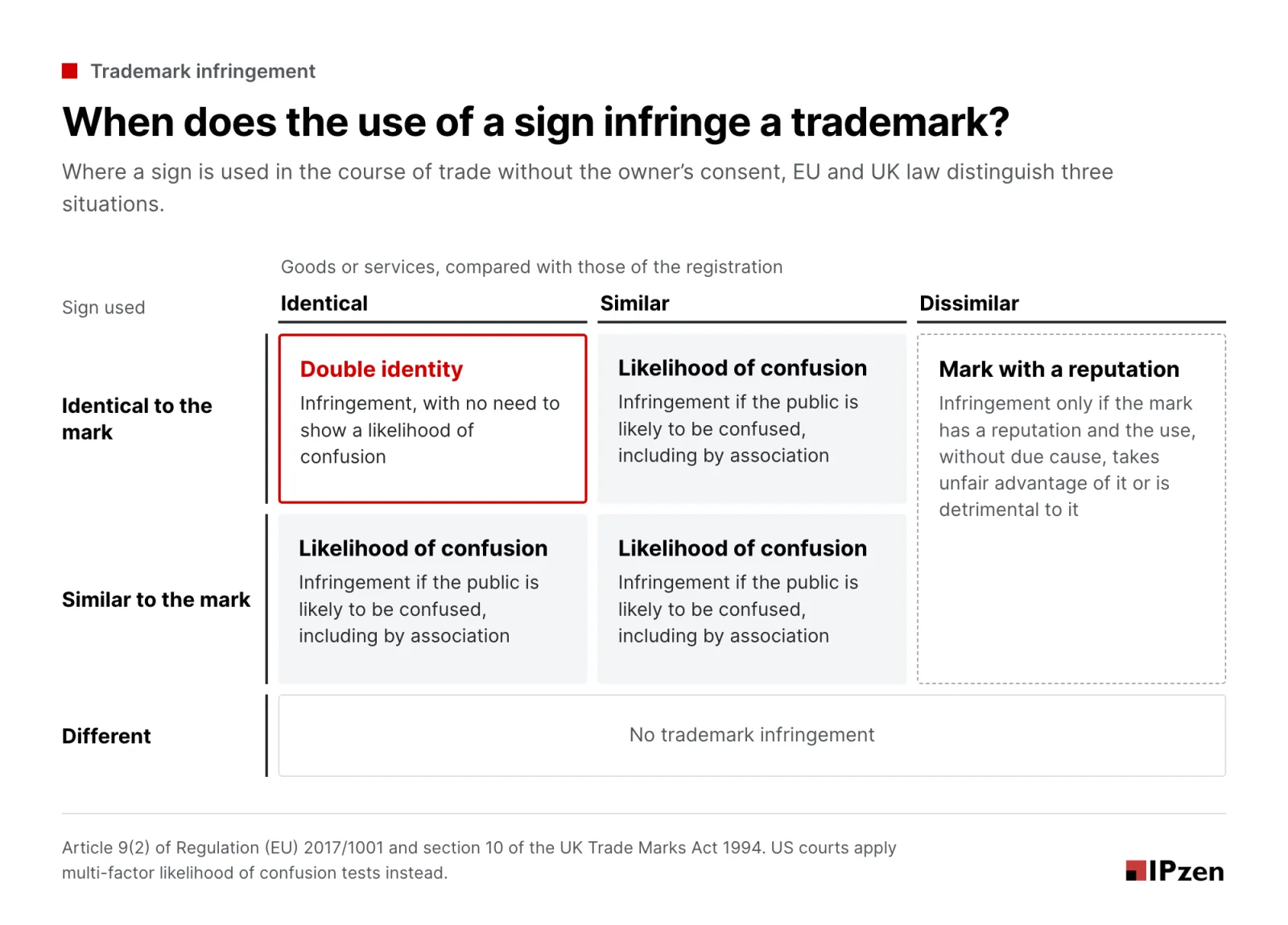
In the European Union, infringement requires several conditions to be met: use of the sign in the course of trade, without the owner’s consent, in the territory covered by the mark, in relation to goods or services, in a way that affects or is liable to affect the functions of the mark, in particular its function of guaranteeing origin (ECJ, 12 November 2002, Arsenal, C-206/01). Where those conditions are met, Article 9 of Regulation (EU) 2017/1001 on the EU trade mark distinguishes three situations: the use of an identical sign for identical goods and/or services, where no likelihood of confusion needs to be shown; the use of an identical or similar sign for identical or similar goods or services, where there is a likelihood of confusion, including a likelihood of association; and the use of a sign that takes unfair advantage of, or is detrimental to, the distinctive character or repute of a mark with a reputation. For example, the use of a sign reproducing a well-known drinks brand to sell clothing may be prohibited, even though the goods are not similar. National laws in EU member states follow the same structure, and the UK Trade Marks Act 1994 (section 10) sets out equivalent rules.
Trademark infringement examples
Infringement takes many forms. The following situations are among the most common in practice:
- Counterfeit goods: Products bearing a sign identical or similar to the mark, presented as genuine, often through online marketplaces or social media.
- Imitation of the mark: A competitor adopts a sign that is visually or phonetically close to an existing mark for the same or related goods.
- Domain names and cybersquatting: A domain name reproduces the mark, sometimes with a typo, to capture internet users looking for the official website and redirect them to another site, sell copies or carry out phishing.
- Impersonation on social media: Accounts or pages use the mark to pass themselves off as the brand or an authorised reseller.
- Keyword advertising: In the EU, the use of a competitor’s mark as a search engine keyword may infringe where the advertisement does not enable average internet users, or enables them only with difficulty, to ascertain whether the goods originate from the trademark owner (CJEU, 23 March 2010, Google France, C-236/08 to C-238/08).
- Use as a company or trade name: A business name that reproduces the mark for similar activities may, depending on the circumstances, be found infringing.
How likelihood of confusion is assessed
Outside cases of double identity, the central question is whether the use is likely to confuse the relevant public as to the origin of the goods or services.
The US multi-factor tests
US courts assess likelihood of confusion using multi-factor tests that vary slightly by circuit, such as the Polaroid factors in the Second Circuit or the Sleekcraft factors in the Ninth Circuit. The factors typically considered include:
- the strength of the plaintiff’s mark;
- the similarity of the marks in appearance, sound and meaning;
- the relatedness of the goods or services;
- evidence of actual confusion;
- the marketing channels used;
- the degree of care likely to be exercised by purchasers;
- the defendant’s intent in selecting the mark;
- the likelihood of expansion of the product lines.
No single factor is decisive, and courts weigh them according to the facts of each case.
The EU global assessment
In the EU, likelihood of confusion must be appreciated globally, taking into account all factors relevant to the circumstances of the case (ECJ, 11 November 1997, Sabel, C-251/95). The assessment is based on the overall impression created by the signs, considering their distinctive and dominant elements, and on visual, aural and conceptual similarity. The factors are interdependent: a lower degree of similarity between the goods may be offset by a higher degree of similarity between the marks, and vice versa (ECJ, 29 September 1998, Canon, C-39/97). The relevant consumer is the average consumer of the goods concerned, reasonably well informed and reasonably observant and circumspect, whose level of attention varies with the category of goods (ECJ, 22 June 1999, Lloyd Schuhfabrik Meyer, C-342/97).
When assessing the similarity of goods and services, the Nice Classification is not determinative in either system: goods in different trademark classes may be found similar, and goods in the same class may be found dissimilar.
Detecting trademark infringement
Enforcement starts with organised monitoring. Infringements now appear across many channels, each requiring different tools:
- trademark registers, to spot applications for identical or similar signs and oppose them in time;
- marketplaces and e-commerce sites, to identify counterfeit or infringing products;
- social media and search engines, where accounts and adverts using the mark proliferate;
- domain names, frequently used for fake shops or phishing campaigns;
- trade fairs and physical distribution channels.
Our 10-step trademark monitoring setup checklist sets out how to build effective monitoring, and our article on cybersquatting and proactive monitoring covers domain name abuse. Not every infringement calls for the same response: it is useful to rank them by degree of similarity, volume, channel and territory.
Building the evidence
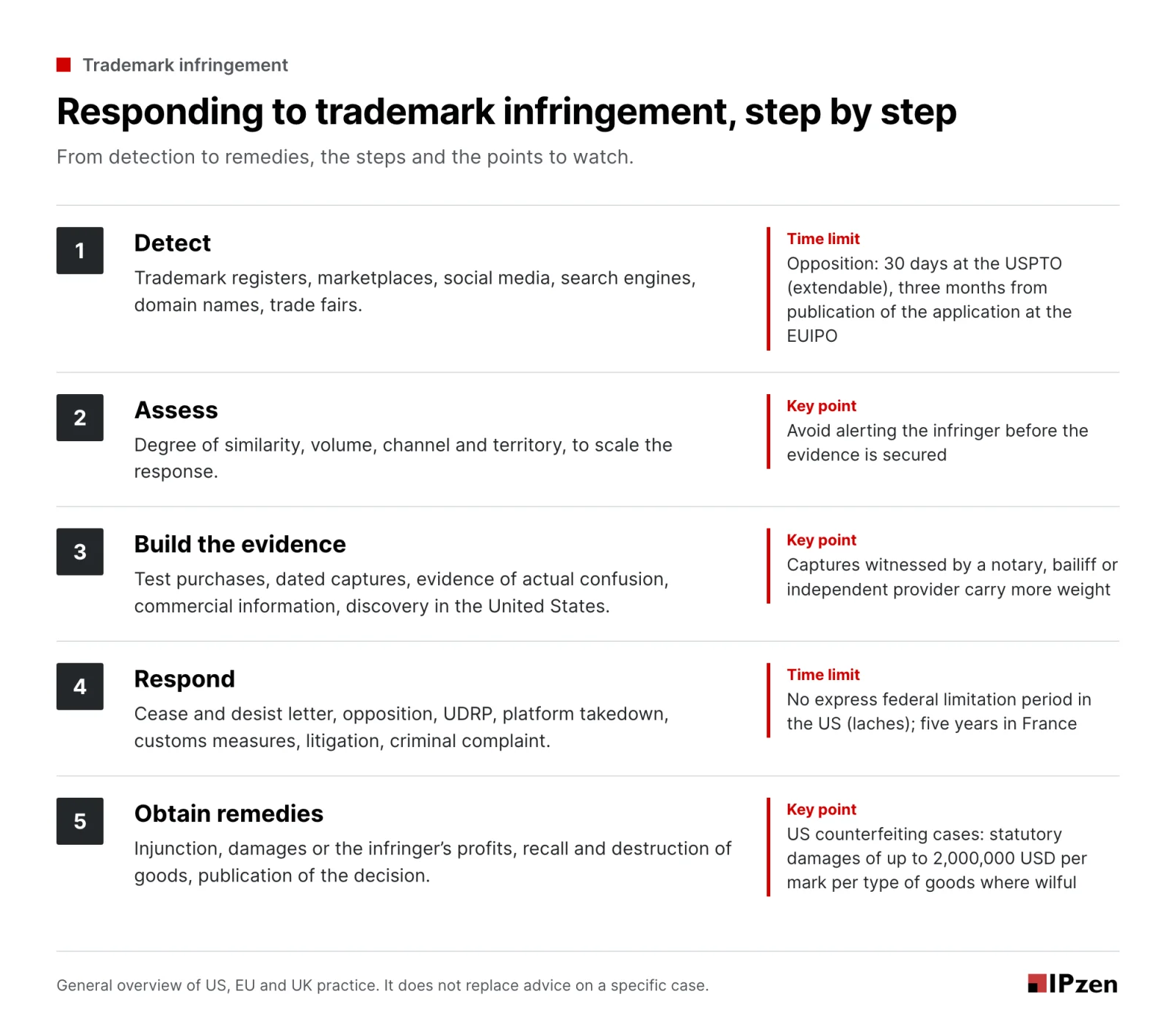
While infringement may generally be proved by any means, the quality of the evidence often determines the outcome. It should also be gathered before the infringer is alerted.
- Test purchases. Buying the infringing product, ideally through an independent investigator, documents the sale, the price, the packaging and the seller’s identity.
- Dated captures. Screenshots and web captures should be dated, complete and reproducible; where the stakes justify it, captures witnessed by a notary, bailiff or independent provider carry more weight.
- Evidence of actual confusion. Misdirected customer enquiries, complaints or reviews referring to the wrong company are particularly persuasive.
- Commercial information. Catalogues, invoices, advertising spend and sales figures help establish the scope of the infringement and the damage suffered.
Procedural tools also exist to obtain evidence held by the other side. In the United States, pre-trial discovery allows the parties to request documents and testimony. In France, a test purchase witnessed by a commissaire de justice (bailiff) must be carried out by a third party independent of the claimant, failing which it may be disregarded, and online reports that comply with standard NF Z67-147 carry greater weight. The saisie-contrefaçon (Article L. 716-4-7 of the Intellectual Property Code), authorised by a court order obtained without notice to the defendant, allows a commissaire de justice, possibly assisted by experts appointed by the applicant, to describe or seize infringing goods and related documents. The merits action must then be brought within twenty working days or thirty-one calendar days, whichever is longer, from the day of the seizure or description, failing which the seizure may be annulled at the request of the party subject to it (Article R. 716-1).
Responding to trademark infringement
Several responses, amicable, administrative or judicial, can be combined depending on the nature of the infringement and the owner’s objectives. Some of them, such as opposition, do not sanction infringement as such, since the mere filing of a trademark application is not in itself an act of infringement, but they help prevent its effects. The table below gives an overview, detailed in the sections that follow.
Scroll the table to read every column.
| Response | Suited to | Point to watch |
|---|---|---|
| Cease and desist letter | Isolated infringement, identified infringer, possible good faith | May alert the infringer before evidence is secured |
| Opposition | Third-party application for an identical or similar mark | 30 days at the USPTO (extendable), three months at the EUIPO |
| UDRP | Domain name reproducing the mark, registered and used in bad faith | Transfer or cancellation only, no damages |
| Platform takedown | Listings on marketplaces and social media | Proof of rights and precise identification of the content |
| Customs measures | Imports of counterfeit goods | Recordation with CBP in the US; EU application valid one year |
| Litigation | Significant infringement, damages sought | Duration and strength of the registration relied on |
| Criminal complaint | Organised or large-scale counterfeiting | Depends on action by the authorities |
Cease and desist letter
A cease and desist letter asks the infringer to stop using the sign and, where appropriate, to give undertakings. It often resolves a minor dispute without litigation. It should nevertheless be drafted carefully: in the United States, an aggressive letter may prompt the recipient to file a declaratory judgment action in a forum of its choosing, and in some European countries unjustified threats or accusations sent to customers may expose the sender to liability. A letter sent too early may also alert the infringer before evidence has been secured.
Settlement options
A coexistence agreement, a licence, an assignment or mediation can end the dispute on terms acceptable to both parties, particularly where the defendant acted in good faith.
Office proceedings
Where the infringement takes the form of a trademark application, opposition allows the owner to challenge registration within short deadlines: 30 days from publication at the USPTO, with extensions available on request, and three months from publication of the application at the EUIPO, with no possibility of extension. Our article on trademark opposition details the procedure. Once a mark is registered, cancellation or invalidity proceedings may be brought before the relevant office or court.
Domain names and online platforms
For domain names, the UDRP offers a fast, out-of-court procedure to obtain the transfer or cancellation of a generic top-level domain registered and used in bad faith; our article on the UDRP procedure explains how it works. Marketplaces and social networks also offer notice-and-takedown mechanisms, which in the EU are reinforced by the notice-and-action obligations of Regulation (EU) 2022/2065, the Digital Services Act (DSA).
Customs measures
Customs authorities can stop counterfeit goods at the border. In the United States, owners of registered trademarks can record them with U.S. Customs and Border Protection, which then monitors imports. In the EU, an application for action under Regulation (EU) No 608/2013 is valid for one year and renewable. Once notified of a detention, the right holder has ten working days, or three working days for perishable goods, to initiate proceedings or agree to the destruction of the goods, failing which they are released. For a right having effect throughout the Union, such as an EU trade mark, a single application may cover several member states, and applications can be filed online through the IP Enforcement Portal (IPEP). Customs may also detain goods on their own initiative and notify the right holder, who then has four working days to file an application for action.
Litigation
In the United States, trademark infringement claims are generally brought before the federal courts. Since the Trademark Modernization Act of 2020, a plaintiff seeking an injunction benefits from a rebuttable presumption of irreparable harm once it has established infringement or a likelihood of success on the merits. In the EU, EU trade mark infringement actions are heard by designated EU trade mark courts in each member state. In all systems, interim measures may be sought, including before any action on the merits, where the infringement is sufficiently likely or imminent.
Criminal proceedings
Trademark counterfeiting is a criminal offence in most jurisdictions. In the United States, trafficking in counterfeit goods is punishable under 18 U.S.C. § 2320. Criminal proceedings are particularly suited to organised counterfeiting, where the investigative powers of the authorities are needed.
Remedies available to the trademark owner
When infringement is established, courts may grant several remedies.
In the United States, the Lanham Act (15 U.S.C. § 1117) allows the owner to recover the defendant’s profits, the damages sustained and the costs of the action, subject to the principles of equity. Since Romag Fasteners v. Fossil (2020), the Supreme Court has held that wilfulness is not a precondition for an award of profits, although it remains an important consideration. In counterfeiting cases, courts may award enhanced damages, and the owner may elect statutory damages instead of actual damages: from 1,000 USD to 200,000 USD per counterfeit mark per type of goods, up to 2,000,000 USD where the use was wilful. Attorney fees may be awarded in exceptional cases.
In the EU, Directive 2004/48/EC on the enforcement of intellectual property rights provides for injunctions, the recall and destruction of infringing goods, damages that take into account lost profits and the infringer’s unfair profits or, alternatively, a lump sum set at no less than the royalties that would have been due had the infringer requested authorisation to use the mark, and the publication of judicial decisions.
Defences to anticipate
Before taking action, the trademark owner should assess the strength of its own rights, since the defendant may raise several defences.
- Non-use and abandonment. In the EU and the UK, a mark that has not been put to genuine use for an uninterrupted period of five years for the goods relied on may be revoked, often by way of counterclaim. The defendant may also require the owner to prove genuine use of the mark, failing which the infringement claim may fail. In the United States, non-use for three consecutive years constitutes prima facie evidence of abandonment. Our trademark use evidence guide explains what to keep on file.
- Invalidity. The defendant may, in particular, argue that the mark lacks distinctiveness, conflicts with an earlier right or was filed in bad faith.
- Fair use. Use by a natural person of their own name, a descriptive term in its ordinary meaning, or the mark to refer to the owner’s goods, for example for spare parts or compatibility, may be lawful where it is consistent with honest practices or, in the United States, qualifies as descriptive or nominative fair use.
- Exhaustion and first sale. The owner generally cannot prevent the resale of genuine goods put on the market under the mark with its consent, within the relevant territory, save for legitimate reasons, in particular where the condition of the goods has been changed or impaired after they were put on the market.
- Delay. In the EU, an owner who has knowingly acquiesced for five successive years in the use of a later registered mark generally loses the right to challenge it, unless the later mark was filed in bad faith. In the United States, unreasonable delay may support a laches defence.
It is also important to check that the registration is in force and renewed, that it covers the relevant territory, and that any assignments or licences have been recorded on the register.
If you are accused of trademark infringement
A business may also find itself on the receiving end, through a cease and desist letter or a complaint. It should then respond in an organised way, rather than ignoring the claim or conceding in haste.
- Preserve the documents. Gather and keep the records relating to the adoption and use of the sign concerned: clearance searches, dates of first use, marketing materials.
- Check the rights relied on. Verify that the claimant’s mark is registered and in force, that it covers the territory and the goods or services concerned, and that it has been genuinely used.
- Assess confusion and the available defences. Prior rights, descriptive or nominative use, non-use or the invalidity of the mark may, depending on the case, be raised.
- Respect procedural deadlines. In US federal court, a defendant must generally serve an answer within 21 days of being served with the summons and complaint, under Rule 12(a) of the Federal Rules of Civil Procedure.
- Consider a negotiated outcome. A coexistence agreement, a phase-out period to sell off existing stock or a rebrand may avoid litigation.
Early advice from a trademark attorney is recommended, particularly where the letter sets a short deadline for a response.
How to avoid trademark infringement
Businesses are not only exposed to infringement by others: when launching a name, a product or a website, they may themselves infringe earlier rights. A few precautions help reduce this risk.
- Run a trademark clearance search before adopting a sign, covering identical and similar signs, the classes concerned and related goods in other classes, as well as unregistered rights where they are protected, such as common law marks in the United States.
- File the mark before launch in each key territory, with a precise specification.
- Check domain names, social media handles and company names against existing marks.
- Control the use of competitors’ marks in advertising, comparative advertising and keyword campaigns.
- Put licences and coexistence agreements in writing, and stay within their scope.
Managing infringement across a trademark portfolio
Enforcement involves short deadlines, large volumes of evidence and several stakeholders: in-house counsel, outside counsel, investigators, customs. Handling it through scattered emails and spreadsheets creates a real risk of missing a decisive deadline, such as an opposition period or a court-imposed time limit.
Effective organisation rests on three principles: one record per infringement, gathering dated evidence and the history of actions taken; tracking of procedural deadlines with named owners; and a link between the record, the registration concerned and the monitoring that detected the infringement.
IPzen’s Case Module structures each trademark dispute in a dedicated space, opened as soon as a notice of opposition, a summons or a report is received. Connected to the calendar, portfolio and watch modules, it sends notifications for response deadlines, hearings, filings and oppositions, and stores briefs, evidence and correspondence in a single document space. The Agenda module completes this follow-up for every deadline in the portfolio.
FAQ
What is trademark infringement?
Trademark infringement is the unauthorised use in commerce of a sign identical or similar to a protected mark, for identical or similar goods or services, in a way that is likely to cause confusion as to their origin. Marks with a reputation are also protected against uses that take unfair advantage of, or harm, their distinctiveness or repute.
What are common examples of trademark infringement?
Common examples include counterfeit goods, look-alike brand names for related products, domain names that reproduce a mark, social media accounts impersonating a brand and, in some circumstances, keyword advertising that misleads users about the origin of the goods.
How do you prove trademark infringement?
The owner must generally establish valid rights in the mark, use of a sign in commerce by the defendant without consent and, outside cases of double identity, a likelihood of confusion. Test purchases, dated captures, evidence of actual confusion and commercial documents form the core of the evidence.
Can you sue for trademark infringement without a registration?
In the United States, yes: Section 43(a) of the Lanham Act protects unregistered marks in which rights have been acquired through use in commerce, although a registration brings significant procedural advantages. In the United Kingdom, an unregistered mark may be protected through an action for passing off. In France and most EU member states, trademark protection generally requires registration, except for well-known marks within the meaning of Article 6bis of the Paris Convention; the owner may otherwise rely on unfair competition, which in France is based on general civil liability (Article 1240 of the Civil Code).
How do you report trademark infringement on Amazon or social media?
Major marketplaces and social networks provide dedicated forms for reporting intellectual property infringements. The report should identify the registration relied on and the infringing listings or accounts by their URLs, with supporting screenshots. Amazon, for example, offers a Report Infringement form, and its Brand Registry programme gives brand owners additional tools.
What is the statute of limitations for trademark infringement?
It depends on the jurisdiction. The Lanham Act does not set an express limitation period for infringement claims; US courts generally apply the doctrine of laches, often by reference to analogous state limitation periods. In France, civil infringement actions are time-barred five years from the day on which the owner knew or should have known of the last fact enabling it to act. Acting promptly is advisable in all cases.
Is trademark infringement a crime?
Ordinary infringement is generally a civil matter, but trademark counterfeiting is a criminal offence in most jurisdictions. In the United States, trafficking in counterfeit goods is punishable under 18 U.S.C. § 2320, and in France trademark infringement is also a criminal offence under the Intellectual Property Code.
In summary
Trademark infringement covers the unauthorised use of an identical or similar sign, in commerce, for identical or similar goods or services where confusion is likely (confusion need not be shown in cases of double identity), as well as harm to marks with a reputation. Enforcing a mark requires fast detection, solid evidence and a choice of the most appropriate response: cease and desist letter, opposition, platform takedown, customs action, litigation or criminal complaint. Above all, it requires a strong registration that is in force, in use and properly recorded.
Official sources
- USPTO – About trademark infringement
- 15 U.S.C. § 1114 – Remedies; infringement
- 15 U.S.C. § 1117 – Recovery for violation of rights
- 15 U.S.C. § 1125 – False designations of origin and dilution
- U.S. Customs and Border Protection – Intellectual property rights
- Federal Rules of Civil Procedure, Rule 12
- Regulation (EU) 2017/1001 on the European Union trade mark
- Directive 2004/48/EC on the enforcement of intellectual property rights
- UK Trade Marks Act 1994, section 10
- ECJ, 11 November 1997, Sabel, C-251/95
- ECJ, 29 September 1998, Canon, C-39/97
- ECJ, 22 June 1999, Lloyd Schuhfabrik Meyer, C-342/97
- ECJ, 12 November 2002, Arsenal, C-206/01
- CJEU, 23 March 2010, Google France, C-236/08 to C-238/08
Book a demo and see how IPzen brings monitoring, dispute files and deadlines together for your trademark portfolio.