

Registering a trademark does not protect a sign in the abstract. It protects it for specific goods and services, which the applicant must list and arrange into trademark classes under the Nice Classification. This choice is often made quickly at the filing stage, yet it shapes the scope of protection for the whole life of the registration, the outcome of any opposition and the strength of the mark against a non-use challenge.
This article explains how the Nice Classification works, sets out the main changes introduced by the 13th edition, which came into force on 1 January 2026, details the classes most often designated and proposes a five-step method for choosing trademark classes. It also covers the most common mistakes and typical class combinations by business type. It is intended for in-house legal teams, IP law firms and companies that manage a trademark portfolio.
What is the Nice Classification?
The Nice Classification is an international system for classifying goods and services, established by the Nice Agreement of 15 June 1957 and administered by the World Intellectual Property Organization (WIPO). It divides goods and services into 45 trademark classes: classes 1 to 34 cover goods, and classes 35 to 45 cover services.
Each class is identified by a class heading, together with an alphabetical list of goods or services and explanatory notes that clarify what the class includes and excludes. The classification is used by the vast majority of intellectual property offices, including the USPTO in the United States, the EUIPO for European Union trade marks, the UK Intellectual Property Office, the INPI in France and WIPO for international registrations under the Madrid System.
Its role is primarily administrative. It standardises the presentation of applications and makes clearance searches easier. It does not, however, have any legal weight of its own when it comes to assessing whether goods and services are similar, a point we return to below.
The 13th edition, in force since 1 January 2026
WIPO revises the classification regularly and, in principle, publishes a new version every year. Since 1 January 2026, applications have been classified under the 13th edition (2026 version). Several goods have moved from one class to another, in particular:
- corrective glasses, sunglasses and contact lenses, which move from class 9 to class 10 (smart glasses remain in class 9);
- emergency and rescue vehicles, which move from class 9 to class 12;
- electrically heated clothing, other than protective or medical clothing, which moves from class 11 to class 25.
Marks filed before that date are generally not reclassified and keep the classification in force at their filing date. Some offices may nevertheless ask for the specification to be brought into line at renewal, and any new application must be classified under the 13th edition. For a large portfolio, it is therefore worth identifying now the registrations that cover goods affected by these transfers.
Why your choice of trademark classes defines the scope of protection
Trademark law is based on the principle of specialty: a mark is protected for the goods and services listed in the registration. Its owner may nevertheless oppose, through opposition or infringement proceedings, the use or registration of an identical or similar sign for similar goods and services where there is a likelihood of confusion. Only marks with a reputation enjoy broader protection beyond that scope, and only under certain conditions.
Two practical consequences follow. First, the scope of protection depends on the wording of the goods and services, not on the class number. Designating class 9 therefore does not protect all the goods that fall within it. Only those expressly listed in the specification are covered. Second, the classification is not enough to assess similarity. Article 33(7) of Regulation (EU) 2017/1001 on the EU trade mark states that goods or services are not to be regarded as similar merely because they appear in the same class, nor as dissimilar merely because they appear in different classes. Clothing in class 25 and bags in class 18 may therefore be found similar, while two very different products may sit in the same class.
The specification must also be drafted with care. Since the IP Translator judgment (CJEU, 19 June 2012, C-307/10), goods and services must be identified with sufficient clarity and precision for the authorities and third parties to determine the extent of protection. The EU Trade Mark Regulation now provides that general indications included in class headings cover only the goods and services clearly falling within their literal meaning (Article 33(5)). In the United States, the USPTO expects applicants to use the wording of its Trademark ID Manual or an equally precise description.
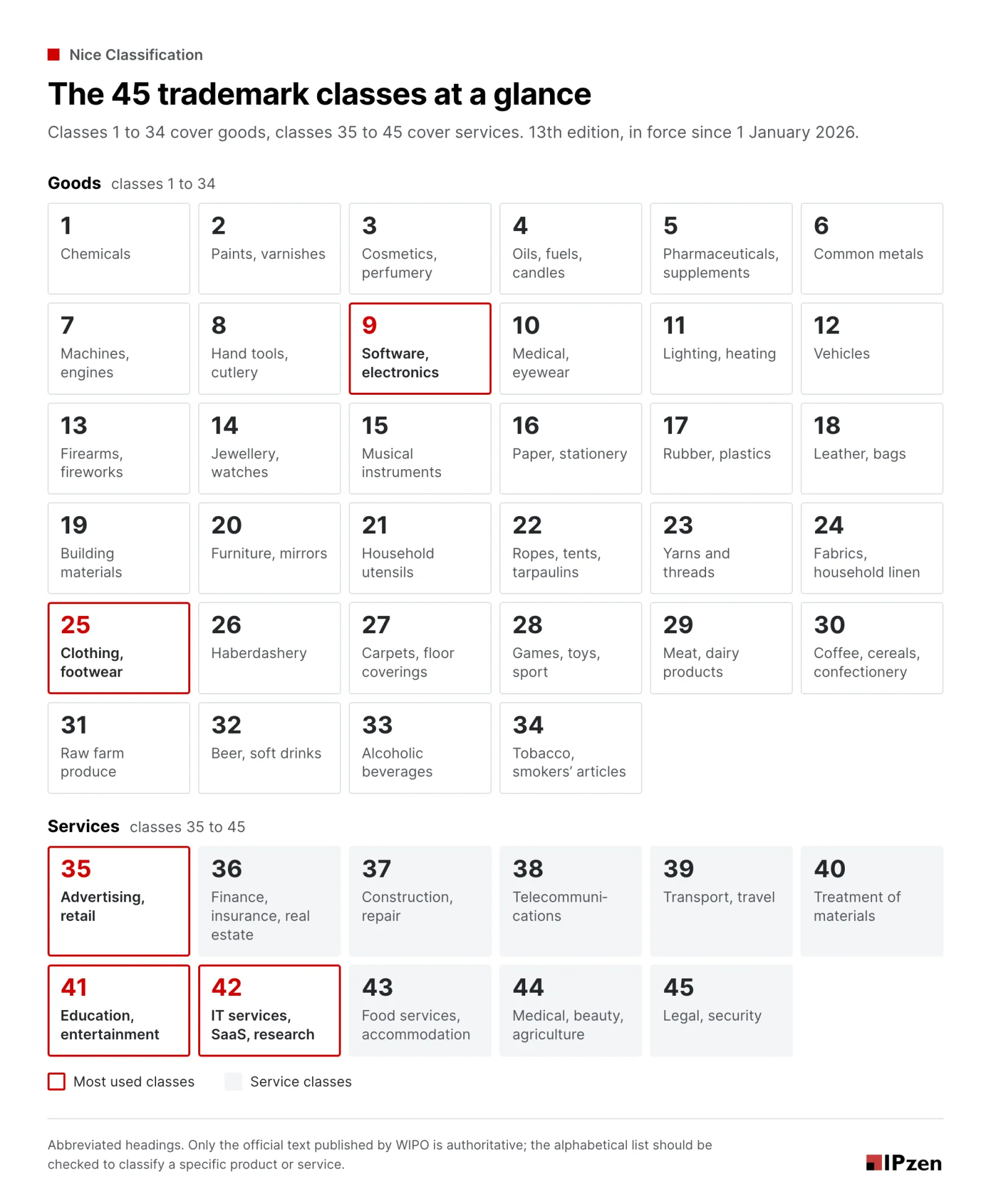
The 45 trademark classes at a glance
The table below summarises the content of each class. The headings are abbreviated: only the official text published by WIPO is authoritative, and the alphabetical list should be consulted to classify a specific product or service.
Scroll the table to read every column.
| Class | Main content |
|---|---|
| 1 | Chemicals for industry, science and agriculture |
| 2 | Paints, varnishes, lacquers, colorants |
| 3 | Non-medicated cosmetics and toiletries, perfumery, cleaning preparations |
| 4 | Industrial oils and greases, lubricants, fuels, candles |
| 5 | Pharmaceutical and veterinary preparations, dietary supplements |
| 6 | Common metals and metal goods |
| 7 | Machines, machine tools, motors and engines |
| 8 | Hand tools and implements, cutlery |
| 9 | Scientific and electronic apparatus, recorded or downloadable software, apps |
| 10 | Medical apparatus, orthopaedic articles; since 2026, spectacles and contact lenses |
| 11 | Apparatus for lighting, heating, cooking, refrigeration and ventilation |
| 12 | Vehicles and apparatus for locomotion; since 2026, emergency and rescue vehicles |
| 13 | Firearms, ammunition, fireworks |
| 14 | Precious metals, jewellery, horological instruments |
| 15 | Musical instruments |
| 16 | Paper, cardboard, printed matter, stationery and office requisites |
| 17 | Unprocessed and semi-processed rubber and plastics, insulating materials |
| 18 | Leather, luggage, bags, umbrellas, saddlery |
| 19 | Non-metallic building materials |
| 20 | Furniture, mirrors, picture frames |
| 21 | Household and kitchen utensils, glassware, porcelain |
| 22 | Ropes, nets, tents, tarpaulins, padding materials, raw textile fibres |
| 23 | Yarns and threads for textile use |
| 24 | Textiles and household linen |
| 25 | Clothing, footwear, headwear |
| 26 | Lace, ribbons, buttons, haberdashery |
| 27 | Carpets, floor coverings, non-textile wall hangings |
| 28 | Games, toys, sporting articles |
| 29 | Meat, fish, dairy products, preserved fruits and vegetables |
| 30 | Coffee, tea, cereals, pastry, confectionery, spices |
| 31 | Raw agricultural and horticultural products, live animals, animal foodstuffs |
| 32 | Beers, mineral waters, non-alcoholic beverages |
| 33 | Alcoholic beverages, except beers |
| 34 | Tobacco, smokers’ articles, electronic cigarettes |
| 35 | Advertising, business management, retail services |
| 36 | Insurance, financial and banking services, real estate affairs |
| 37 | Construction, repair, installation services |
| 38 | Telecommunications |
| 39 | Transport, packaging and storage, travel arrangement |
| 40 | Treatment of materials, custom manufacturing |
| 41 | Education, training, entertainment, sporting and cultural activities |
| 42 | Scientific and technological services, software design and development, software as a service (SaaS) |
| 43 | Food and drink services, temporary accommodation |
| 44 | Medical and veterinary services, hygienic and beauty care, agriculture services |
| 45 | Legal services, security services, personal and social services |
A closer look at the most used classes: 9, 25, 35, 41 and 42
Some classes appear in a large share of applications, because they cover digital businesses, fashion, commerce and services. As their boundaries are not always intuitive, their content deserves a closer look.
Class 9 trademark: software, apps and electronic apparatus
Class 9 covers, in particular, scientific apparatus and instruments, data processing equipment, recorded or downloadable software, mobile apps and downloadable electronic publications. It also includes downloadable digital files authenticated by non-fungible tokens (NFTs). Since the 13th edition, spectacles and contact lenses no longer fall into class 9, with the exception of smart glasses. For a digital business, class 9 is generally combined with class 42, which covers services provided online.
Class 25 trademark: clothing, footwear and headwear
Class 25 covers clothing, footwear and headwear. Some garments nevertheless fall into other classes because of their function: clothing for protection against accidents belongs in class 9, while special clothing for operating theatres and orthopaedic footwear belong in class 10. Since 1 January 2026, electrically heated clothing has been classified in class 25. A fashion brand often designates class 18 for leather goods and class 14 for jewellery and watches as well.
Class 35 trademark: advertising, business and retail services
Class 35 brings together advertising, business management, organisation and administration, and office functions. It also includes the bringing together, for the benefit of others, of a variety of goods, enabling customers to conveniently view and purchase them, in other words retail services, whether in store or online. These services must specify the goods concerned, as explained below. Financial services, in particular, are excluded, as they fall into class 36.
Class 41 trademark: education, training and entertainment
Class 41 covers education, training, entertainment, and sporting and cultural activities. It includes, among other things, arranging conferences and seminars, publishing books and providing online electronic publications that are not downloadable. The boundary with class 35 depends on the purpose of the service: organising exhibitions for cultural or educational purposes falls into class 41, whereas organising trade fairs for commercial or advertising purposes falls into class 35.
Class 42 trademark: IT services, SaaS and research
Class 42 covers scientific and technological services, industrial research, and the design and development of computer hardware and software. It includes software as a service (SaaS), platform as a service (PaaS), website and data hosting, and information technology consultancy. Since the 13th edition, it also refers to artificial intelligence as a service (AIaaS). For a software publisher, it forms, together with class 9, the core of trademark protection.
How to choose trademark classes: a five-step method
Choosing trademark classes involves weighing the scope of protection sought against the ability to make full use of the mark. The following method helps structure that decision.
- Start from actual business activity: List the goods and services actually sold under the mark, or whose launch has been decided, describing them in concrete terms rather than broad categories.
- Anticipate developments over five years: In the EU, the UK and France, a mark that has not been put to genuine use for an uninterrupted period of five years for a product or service included in the specification may be revoked for that product or service; in the United States, registrations must be supported by use in commerce. It therefore makes sense to cover foreseeable medium-term extensions, without claiming goods the business has no intention of using. Our trademark use evidence guide sets out what to keep on file.
- Draft a clear and precise specification: Rely on WIPO’s alphabetical list, the harmonised terms of the EUIPO’s TMclass tool or the USPTO’s Trademark ID Manual, which make it easier for offices to accept the application. Overly vague terms may be objected to by the office or interpreted narrowly.
- Check availability in each class: A trademark clearance search should cover the classes designated, but also similar goods and services that fall into other classes.
- Think at portfolio level: Each class designated will have to be used, monitored and renewed in every territory concerned. The decision should therefore be made at portfolio level and over the full life of the registration.
Common mistakes when choosing trademark classes
Several mistakes recur in trademark applications, and their consequences sometimes only become visible years later.
Filing too broadly
Covering entire classes “just in case” exposes the mark to several risks. In the Sky judgment, known as “SkyKick” (CJEU, 29 January 2020, C-371/18), the Court held that filing without any intention of using the mark for certain goods or services may, in some circumstances, amount to bad faith for those goods or services, where the applicant intended to undermine the interests of third parties or to obtain an exclusive right for purposes other than those falling within the functions of a trade mark. The Court nevertheless made clear that a lack of clarity and precision in the specification is not, in itself, a ground of invalidity. A broad specification also becomes a target for revocation for non-use once the five-year period has elapsed.
Filing too narrowly
Conversely, a specification limited to existing products may leave a natural extension of the business unprotected. Goods and services cannot be added after filing: a new class or a new product requires a new application, with a new filing date.
Confusing goods with services
A software company may need class 9 for downloadable software and apps, and class 42 for software provided online (SaaS), software design and development or data hosting. Leaving out either class creates a gap in protection for an offer that often combines both delivery models.
Drafting retail services poorly
Selling goods that you manufacture yourself is not a class 35 service. Retail services in class 35 cover the activity of distribution, and the Court of Justice accepted their protection provided the goods or types of goods concerned are specified (ECJ, 7 July 2005, Praktiker, C-418/02).
Examples of class combinations by business type
The following table gives combinations that are frequently seen in practice. It does not replace a case-by-case analysis, which depends on the business model and the company’s plans.
Scroll the table to read every column.
| Business | Classes often designated |
|---|---|
| SaaS software publisher | 9, 42, and where relevant 35 and 38 |
| Clothing and accessories brand | 25, 18, 14, and 35 for retail services |
| Cosmetics brand | 3, 5 for certain treatment products, 35, and 44 for salons |
| Restaurant or restaurant chain | 43, 29 and 30 for products sold, 35 |
| Wines and spirits | 33, 35, and 41 or 43 for tastings and events, depending on their nature |
| Training provider | 41, 16 for printed materials, 9 for downloadable content |
| Consultancy firm | 35, 41, and 45 for legal services |
Trademark classes at the heart of portfolio management
Classes are not only relevant at the filing stage. They shape portfolio management throughout the life of each registration.
- Monitoring: Watch services filter new filings by class and by the goods designated; their settings should take into account similar goods that fall into other classes. Our 10-step trademark monitoring setup checklist explains how to proceed.
- Opposition: The comparison of goods and services is, together with the comparison of the signs, one of the two pillars of the likelihood-of-confusion analysis. Our article on trademark opposition details the procedure and deadlines.
- Renewal: Each renewal is an opportunity to check, class by class, whether protection is still useful and in use.
- International expansion: The goods and services designated in the basic mark determine the maximum scope of an international registration; our article on international trademark protection routes presents the options.
In IPzen, the trademark report shows the country, classes, status and renewal date of each registration. It makes it easy to see which classes are covered in which territories, and to identify the registrations affected by a change in the classification or by an upcoming deadline. IPzen’s trademark management software brings this information together on a single dashboard.
FAQ
How many trademark classes are there?
The Nice Classification has 45 trademark classes: classes 1 to 34 cover goods and classes 35 to 45 cover services. Since 1 January 2026, applications have been classified under the 13th edition.
Can I add a class after filing?
No. The list of goods and services cannot be extended after filing; it can only be limited. Protecting new goods or services requires a new application, with its own filing date.
Which class should I choose for software?
Recorded or downloadable software and apps fall into class 9. Software provided online (SaaS) and software design and development fall into class 42. An offer that combines both delivery models generally justifies filing in both classes.
Can the same trademark be registered by different owners in different classes?
In principle, yes. Under the principle of specialty, two identical marks owned by different businesses may coexist where they cover different goods or services and no likelihood of confusion arises. This coexistence has its limits, however, where the goods are similar despite falling into different classes, or where the earlier mark has a reputation.
Which trademark class covers clothing?
Clothing, footwear and headwear fall into class 25. A fashion brand often also designates class 18 for bags and leather goods, class 14 for jewellery and watches, and class 35 for retail services.
Which trademark class covers food?
Food products are spread across several classes: class 29 for meat, fish, dairy products and preserved fruits and vegetables, class 30 for coffee, tea, cereals, pastry and confectionery, and class 31 for raw agricultural products. Beverages fall into class 32 (beers and non-alcoholic drinks) and class 33 (alcoholic beverages), while restaurant services fall into class 43.
In summary
The Nice Classification sorts goods and services into 45 trademark classes, but the protection a mark enjoys depends above all on the wording of its specification. A well-considered choice of classes starts from actual business activity, anticipates developments over five years, relies on precise terms, checks the availability of the sign and is part of portfolio management over the full life of the registration. Since 1 January 2026, the 13th edition has moved several products from one class to another, which justifies a review of the portfolios concerned.
Official sources
- WIPO – Nice Classification
- European Commission, IP Helpdesk – New edition of the Nice Classification enters into force in 2026
- USPTO – Trademark ID Manual
- EUIPO – TMclass
- CJEU, 19 June 2012, IP Translator, C-307/10
- CJEU, 29 January 2020, Sky and Others, C-371/18
- ECJ, 7 July 2005, Praktiker, C-418/02
Book a demo and see how IPzen helps you track the classes, territories and deadlines of your trademark portfolio.